Kategori
Last updated: November 26, 2026 · Water safety equipment
A water safety emergency kit keeps docks, boats, flood zones and rescue teams ready in seconds. Rescue line throwers, throw bags, whistles, lifebuoys and boating safety gear follow one checklist, so homes, marinas and agencies stay prepared when someone falls in.
This guide covers the essentials, distance and close-range rescue, signaling, supplier confirmation and care.
 |
|
Table of contents
Water claims lives in seconds, and the water safety kit answers with the same layers every time: line throwers for distance, throw bags for close range, whistles for attention, lifebuoys for flotation and boating safety gear for the vessel.
The layers are stocked once and practiced twice a year, so the dock, the boat and the rescue team all react without a search.
The dock post, the boat locker and the rescue truck follow the same drill: the thrower is tested with a dry run, the bag is tossed twice to check the aim, the whistle is blown once to check the tone, and the buoy is lifted to check the strap, so the practice session becomes the quarterly maintenance record.
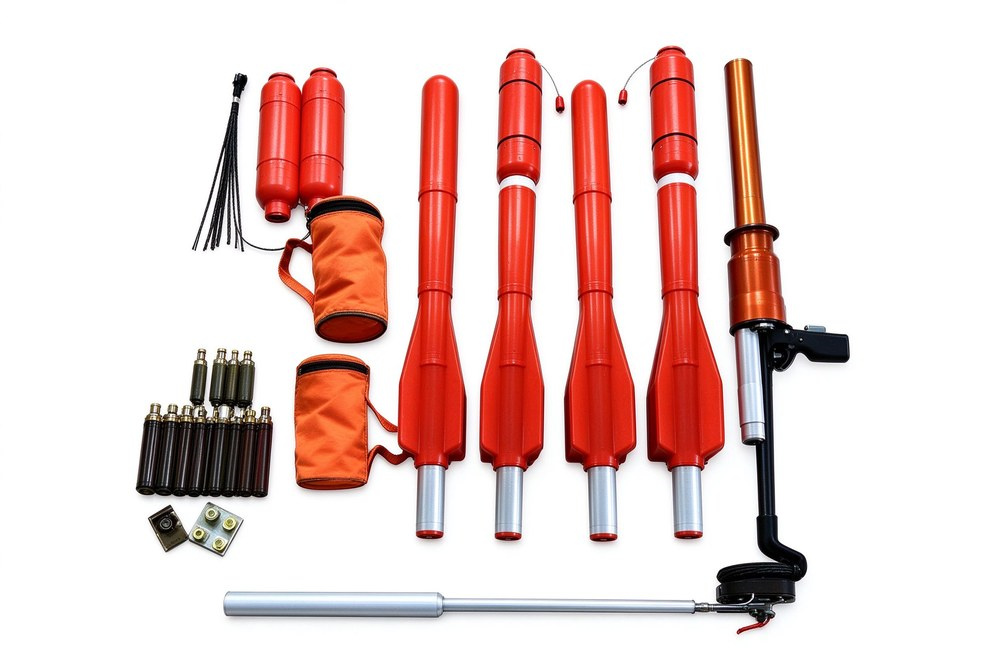
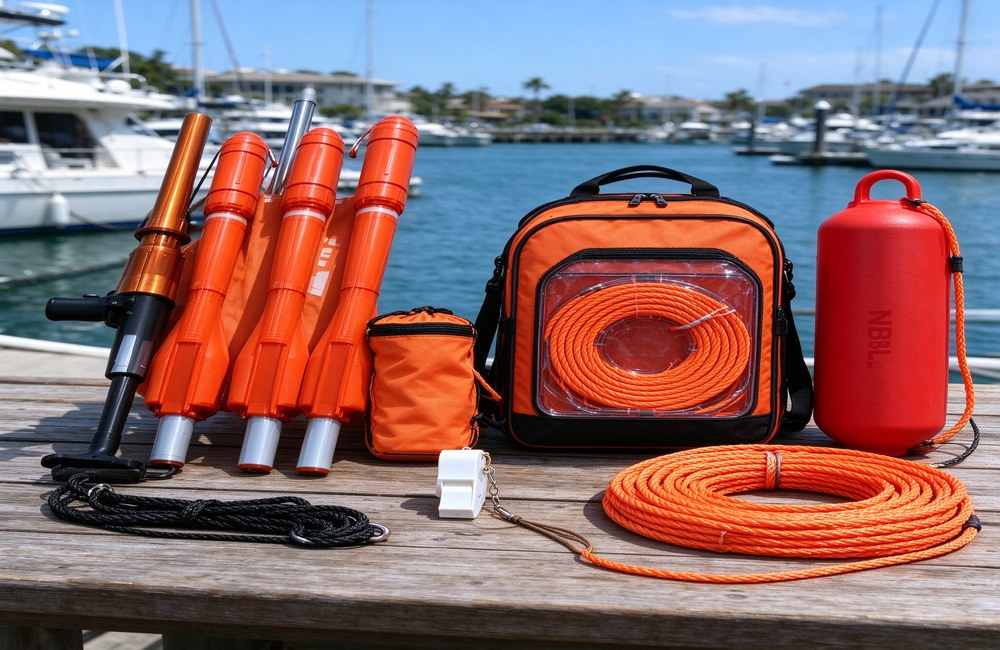
Portable rescue line thrower with launch tube, grip and rope spool on white background, bulk rescue line throwers ready for the water safety equipment order
The sections follow the rescue chain: why the gear matters, the core checklist, the distance layer, the close-range layer, signaling, flotation, boating, floods and coastal storms, rescue team versions, confirmation points and supplier checks.
The order matters because each layer answers a different second of the emergency: distance for the victim who is far, close range for the victim who is near, signaling for the moment the responder cannot be seen, flotation for the seconds before the line arrives, and boating safety for the vessel that carries the whole kit.
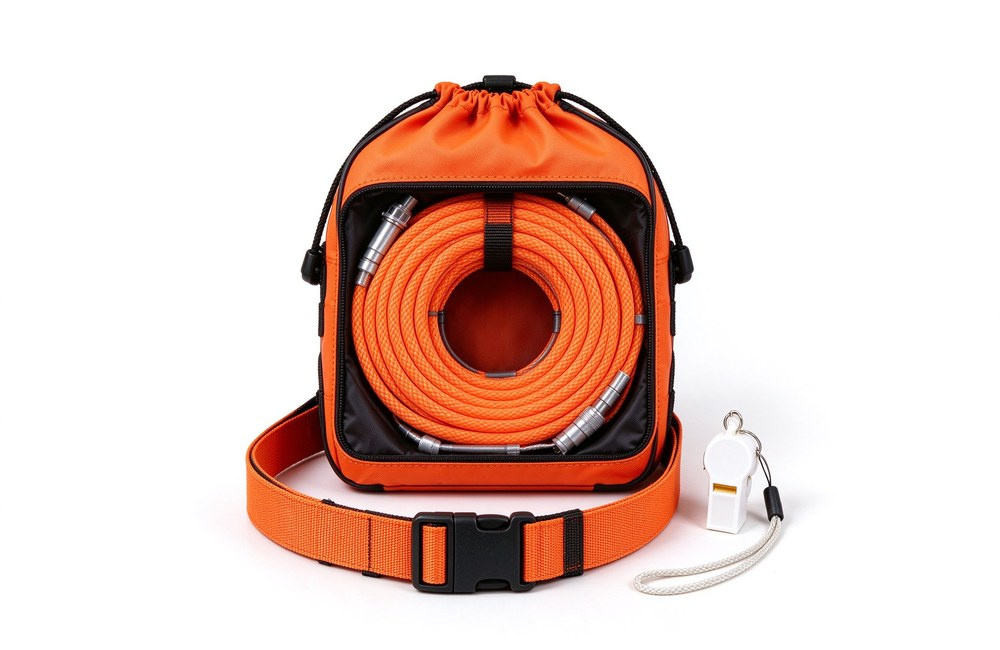
Orange rescue throw bag with waist strap and a white emergency whistle beside it, rescue throw bags wholesale and emergency whistles bulk for dock use
The guide serves a family, a marina, a school and a fire department the same way: stock the right gear, practice the throw, check the dates, and confirm the order details with the factory before the season opens.
A family dock, a marina walkway and a fire department truck run the same layers at different volumes, and the supplier question stays the same in every version: confirm the distance, confirm the rope, confirm the documents before the season opens.
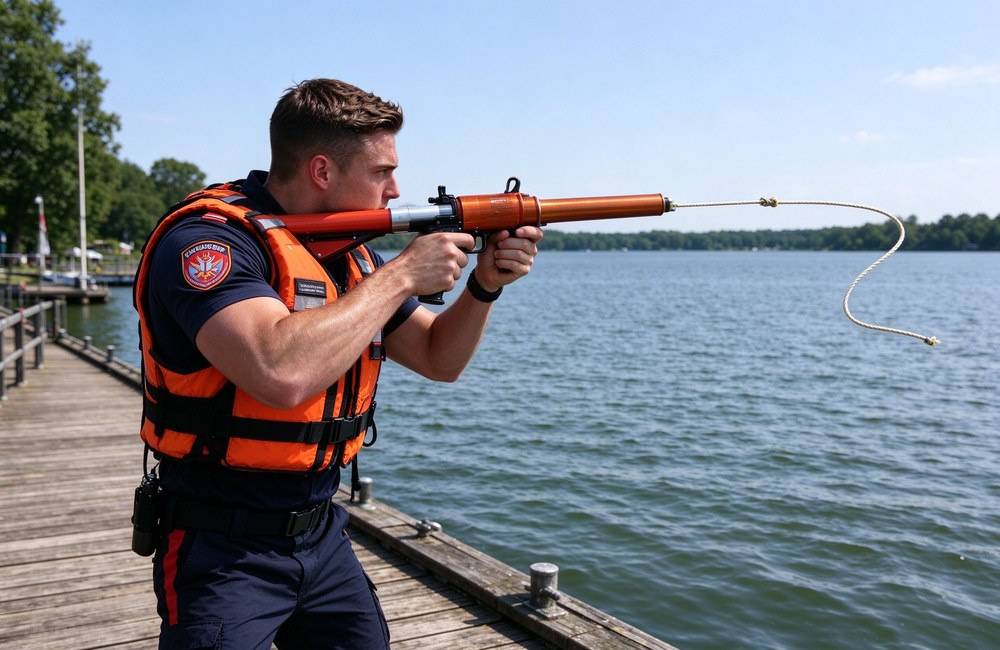
A foreign lifeguard throwing a rescue line from a dock toward the lake, dock safety gear in action for the water safety equipment guide
By the end you will know what belongs in a water safety kit, how a rescue line thrower differs from a rescue throw bag, how many whistles a team needs, and what documents to confirm with a line thrower supplier for bulk rescue line throwers and rescue throw bags wholesale.
The same checklist also covers the quarterly maintenance and the supplier confirmation, because a water safety kit that is stored since last summer and never drilled fails the rescue minute long before the rope runs out.
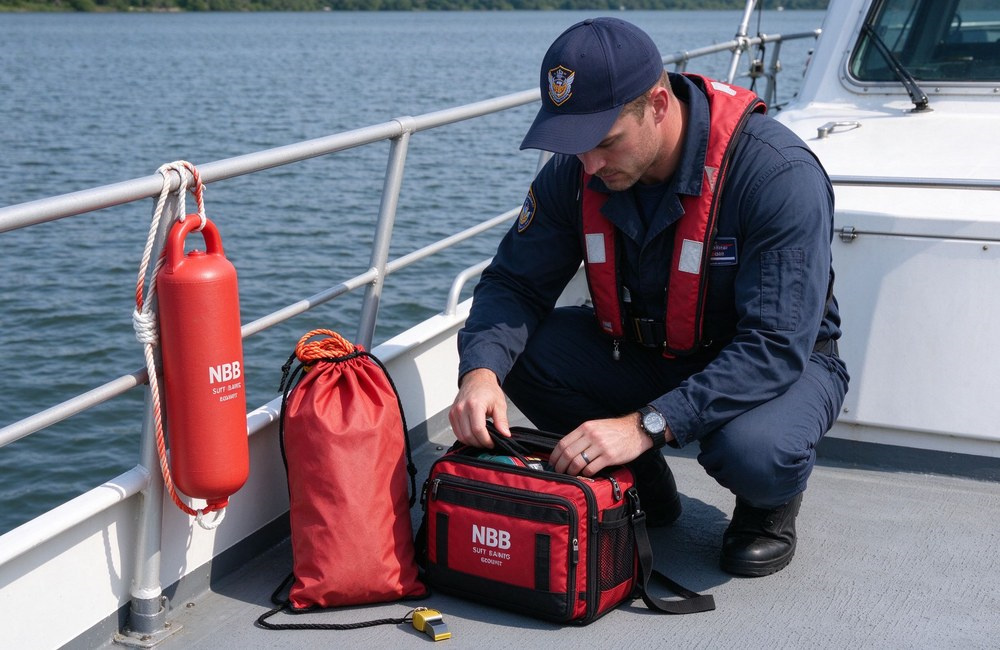
Foreign crew checking a water safety kit on a boat deck with a rescue float and throw bag, boating safety gear for the water safety equipment checklist
A water safety kit turns seconds into a rescue.
When someone falls from a dock, a boat or a flood edge, the thrower, the bag, the whistle and the buoy give the responder a way to help from a safe distance, before fatigue and cold take over.
The kit is not a locker of spare parts; it is a response routine in a bag.
The thrower covers the distance, the bag covers the close range, the whistle covers the attention and the buoy covers the flotation, and each layer is one reach away from the water edge.
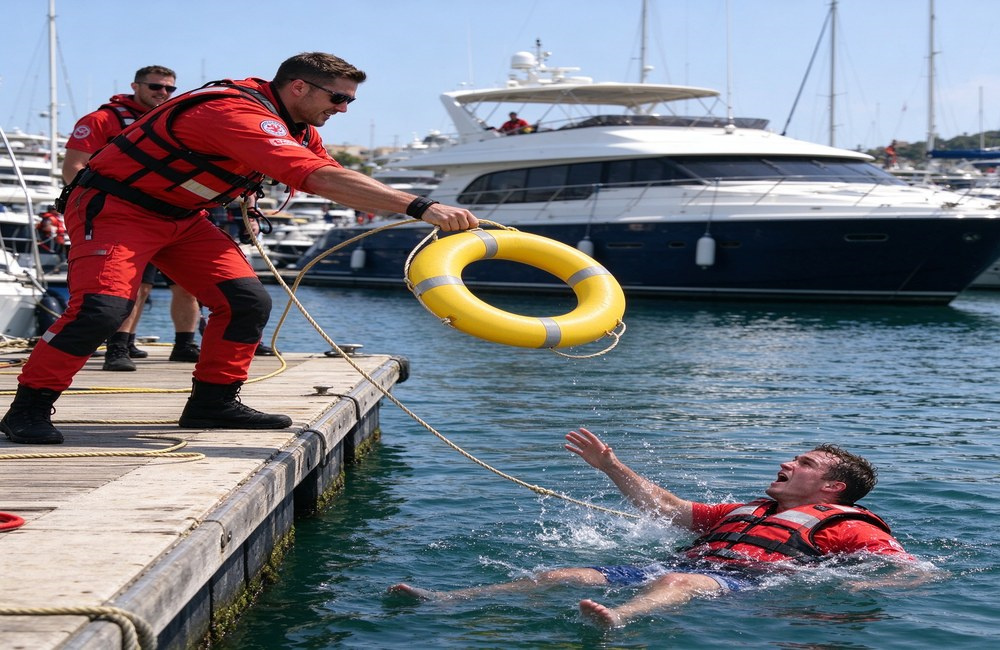
Foreign rescue staff throwing a lifebuoy to a person in water at a marina, dock safety gear in a real rescue drill
Drowning is often silent and fast: a weak swimmer can slip under in the time it takes to look away, and panic does not produce a splash or a call. Gear that is already in place matters more than a search after the fact.
The NWS water and rip current safety guidance and the American Red Cross water safety guidance frame the core drowning prevention gear every dock and boat should carry. Keep the Red Cross survival kit supplies checklist beside the kit during drills.
A stocked kit removes the decision: the throw bag hangs on the dock post, the line thrower sits in the boat locker, and the whistle rides on the lifeguard lanyard.
The responder reaches the gear in one step instead of five, and the victim receives flotation or a line within the first minute.
The stocked kit also removes the hesitation: the responder does not argue about which tool to grab, because the post holds the bag, the locker holds the thrower and the lanyard holds the whistle.
The victim receives flotation or a line within the first minute, and the rescue stays on dry ground.
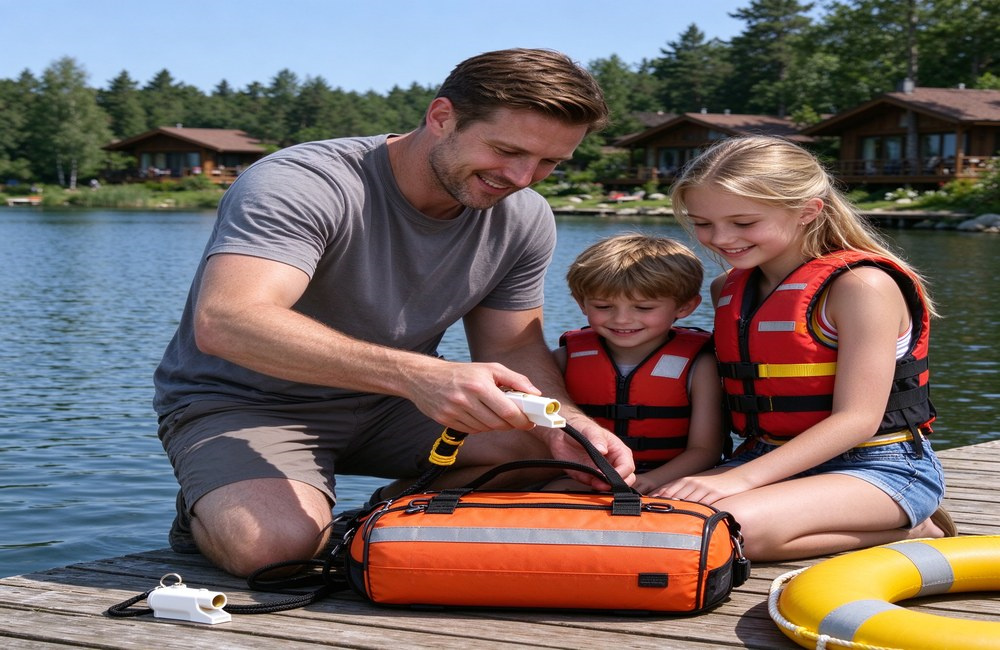
A foreign family checking water safety gear at a lake dock, rescue throw bag, whistle and lifebuoy for the water safety equipment kit
The core is the five layers every water safety kit carries: a distance thrower, a close-range bag, a signaling whistle, flotation and the storage that keeps them reachable.
The list below is the working core, and the quantities are sized for one dock or one boat.
The quantities follow the water: one distance thrower per dock, two throw bags per post, three whistles per station, two lifebuoys per rack and one storage bag per set, then the spares that make the kit usable instead of merely stocked.
Layer
Core item
Quantity
Check
Distance
Rescue line thrower
1 per dock
Quarterly
Close range
Rescue throw bags
2 per post
Quarterly
Signaling
Emergency whistles
3 per station
Seasonal
Flotation
Lifebuoys
2 per rack
Seasonal
Storage
Waterproof bag
1 per set
Seasonal
The table above maps the five layers to the quantities: the columns show the layer, the core item, the quantity and the check cycle.
Buyers turn the same columns into a water safety equipment order, and the quantities scale from one dock to a whole marina or a rescue fleet.
The check cycle column keeps the whole kit honest: distance and close range are drilled quarterly, signaling follows the lanyard check, and flotation follows the buoy inspection, so every layer is verified on a calendar, not by memory.
The dock kit holds one rescue line thrower for distance, two rescue throw bags for close range, three emergency whistles for signaling, two lifebuoys for flotation and a waterproof bag for the whole set.
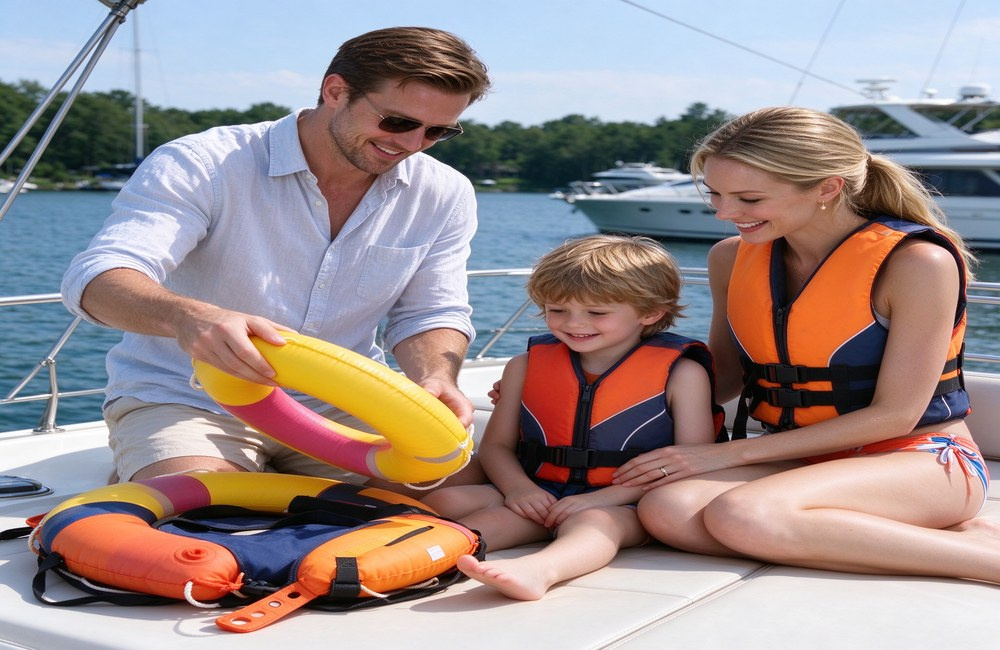
The boat kit swaps the dock post for a locker and adds the boating safety gear: jackets for every person, a throwable buoy and a waterproof torch, because the rescue point on a boat is the vessel itself.
Gear that is locked away is gear that is not there.
The kit box hangs open with the label facing out, the throw bag sits in a quick-release holder and the whistle rides on a lanyard, so every layer is one reach away from the water edge even in the dark.
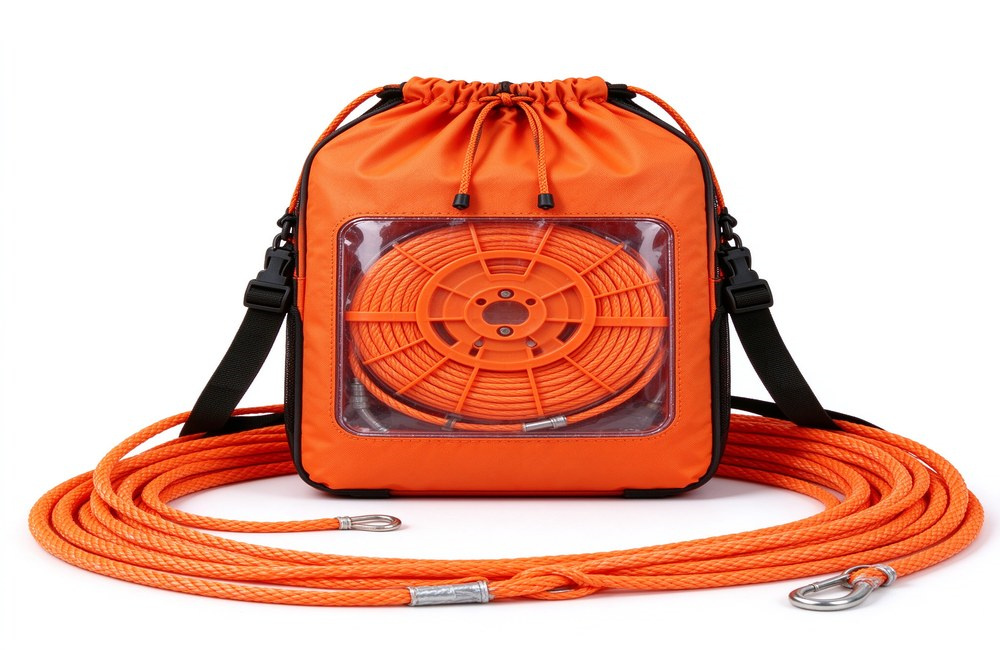
Orange rescue throw bag with uncoiled rope and metal hook on white, rescue throw bags wholesale for close range rescue
A rescue line thrower sends a rope 80 to 230 meters across water, powered by compressed air instead of an arm.
It is the layer for the victim who is beyond throwing range, the current that pulls a swimmer offshore, and the flood window that keeps responders on dry ground, and its rope pull strength is the number the buyer confirms first.
The thrower launches a rope with a weighted head: the trigger releases compressed air, the rope uncoils behind the head, and the responder or the victim pulls the line back to the shore.
Models differ by distance and power, from portable 80-meter units to long-range 230-meter systems with a rope pull strength above 2000 newtons, and the launch is powered by compressed air so there is no flame and no recoil risk on the dock.
The rope uncoils behind the head in a straight line, the responder holds the trigger steady and the victim grabs the line below the surface, so the pull is straight and the rescue stays on dry ground.
Match the thrower to the water: a marina needs a portable unit that one lifeguard carries, a rescue fleet needs long-range units for offshore and flood work, and a fire department needs the models that pair with their existing nozzles and reels.
Buy bulk rescue line throwers with the same confirmation checklist as every other water safety equipment order.
A marina needs a portable unit that one lifeguard carries, a rescue fleet needs long-range units for offshore and flood work, and a fire department needs the models that pair with their existing nozzles and reels, so the bulk order is sized by the water, not by the catalog.
Air systems need a quarterly check: the canister pressure, the trigger, the rope condition and the storage case. Rope is replaced after any wet deployment, because wet rope weakens and the next launch may be the one that matters.
Rope is replaced after any wet deployment, because wet rope weakens and the next launch may be the one that matters, and the storage case keeps the trigger and the canister dry between the checks.
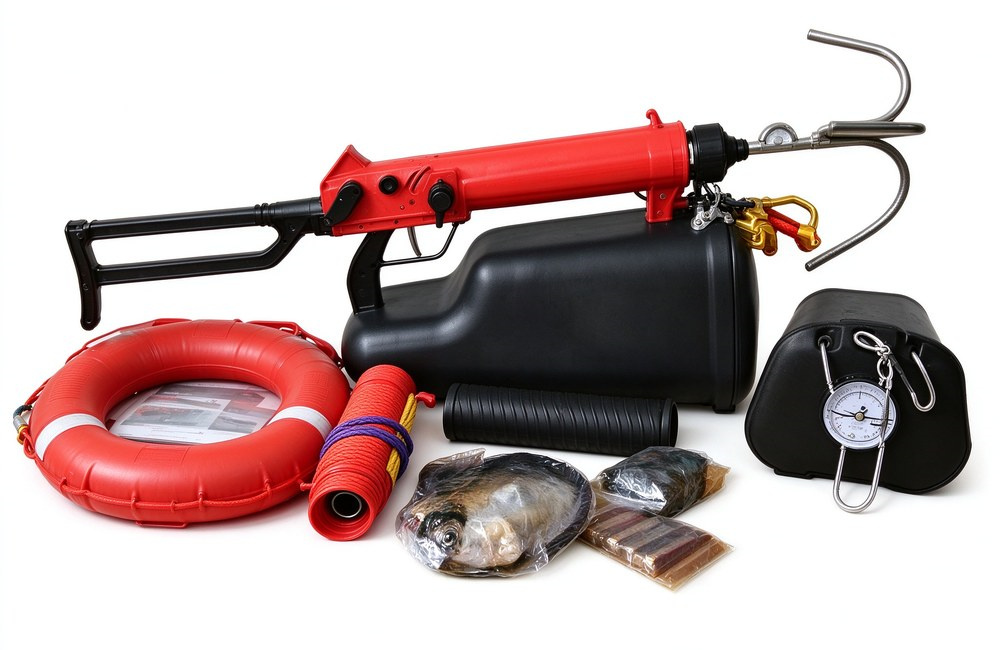
American style rescue line thrower set with launcher, air canister and rescue ring on white, bulk rescue line throwers for rescue team use
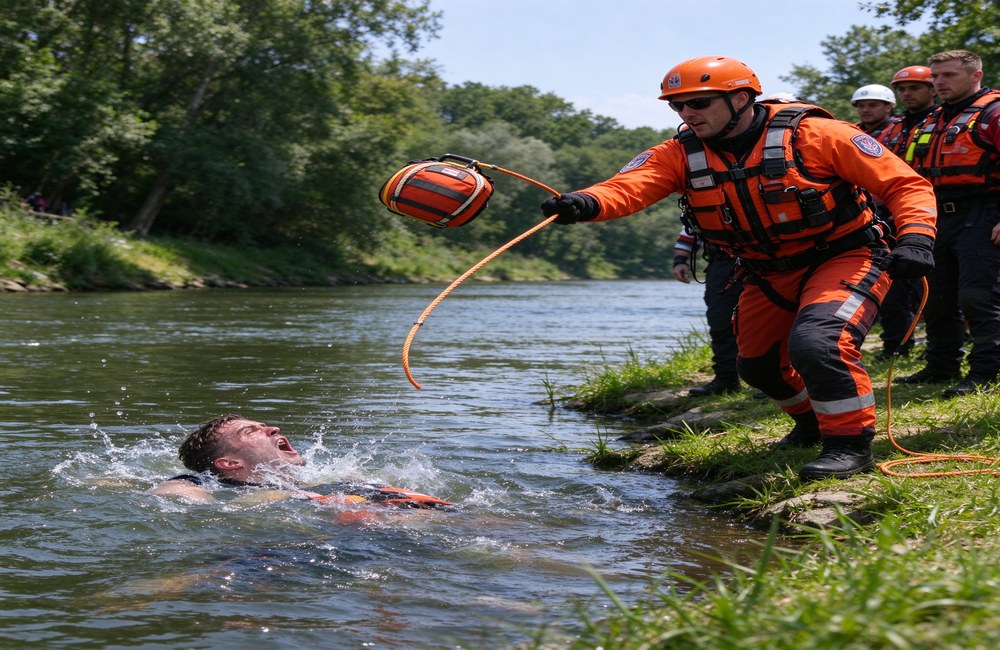
A rescue throw bag is the reach-or-throw answer for the victim within 20 to 30 meters: the responder tosses the bag past the swimmer, the rope uncoils, and the victim grabs the line while the responder stays on the bank or the dock.
Official water safety guidance teaches reach or throw, do not go: a responder who jumps in becomes a second victim, while a throw bag, a reach pole or a line keeps the rescue on dry ground.
The throw bag is the fastest close-range tool because it is one motion and one aim.
A good bag holds 15 to 25 meters of floating rope, closes with a quick cinch, and floats after the toss so the swimmer can grab the tail.
Buyers check the rope diameter, the bag buoyancy and the stitching, because every order from this water rescue throw bag supplier is only as strong as the weakest seam, and the floating rope keeps the tail within reach even when the bag lands beyond the swimmer.
A throw bag is a practiced skill, not a stored tool. Two drills a year teach the aim, the distance and the rope management, and the same drills check the gear: the cinch, the line and the bag shell, so the practice is the maintenance.
A whistle turns a voice into a signal that carries across wind, water and engine noise. Three short blasts mean distress in boating convention, and a whistle that lives on the lifeguard lanyard or the life jacket is always with the wearer, so the signal is never a search away.
Sound carries farther than a shout, and a whistle does not fatigue. Rescue teams and lifeguards buy emergency whistles bulk because the same whistle works for pool drills, dock patrols and boat checks, and one lanyard keeps it attached through every season without a pocket search.
The whistle rides on a breakaway lanyard so it does not snag, the pea chamber stays dry, and the lanyard is checked with the seasonal restock, and the spare whistles live in the kit box. Whistles are cheap, but a whistle that is not on the person is not in the kit.
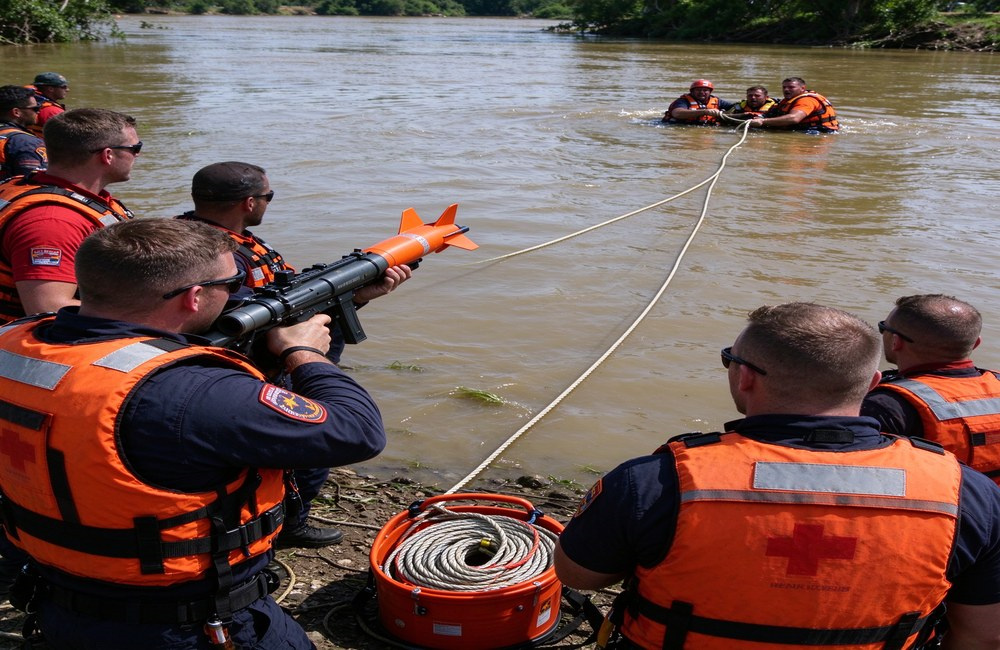
A lifebuoy is the flotation layer that does not need a skill to use: the victim holds the ring, the responder pulls the attached line, and the buoy does the floating while the person focuses on breathing, so the buoy works for a weak swimmer and a strong swimmer alike.
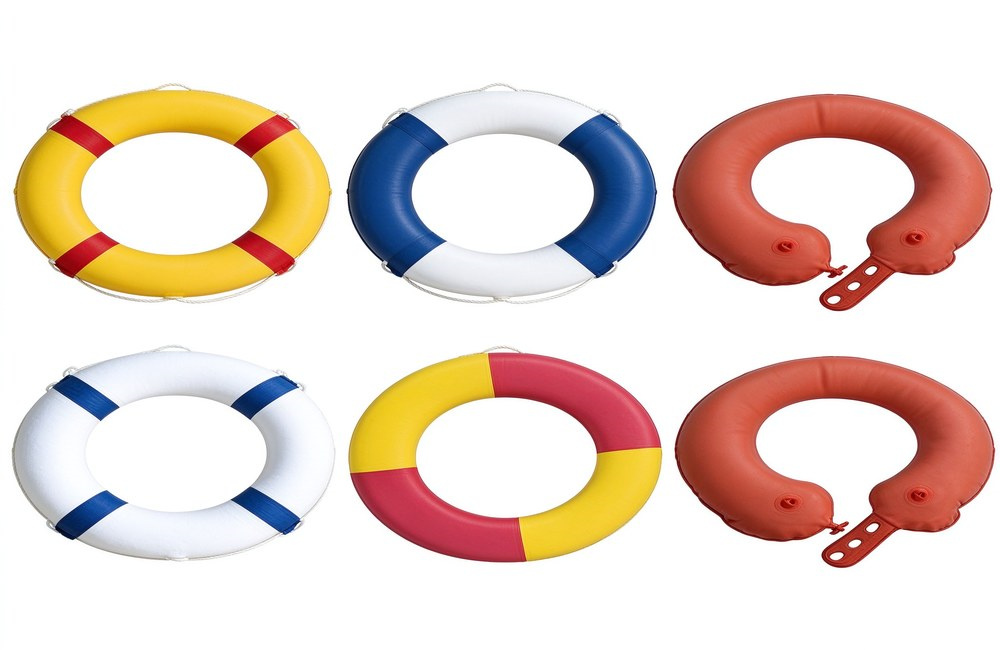
Lifebuoys come in plastic, PU, foam, EVA, rubber and horseshoe shapes, and each material answers a different water: foam and EVA suit lakes and pools, rubber suits marine use, and horseshoe buoys suit rescue reels.
Foam and EVA suit lakes and pools, rubber suits marine use and horseshoe buoys suit rescue reels, so lifebuoys wholesale orders mix the types to match the dock, the boat and the rescue station.
A dock post carries the throw bag, the ring and the whistle at chest height, one step from the water edge, with the line coiled free so nothing tangles in the moment of use, and the post label lists the five layers so the responder checks the whole set without opening the box.
A boat carries its own water safety kit, because the rescue point is the vessel itself. Life jackets for every person, a throwable buoy, a whistle, a line and a first aid pouch cover the checklist before the engine starts.
Official boating safety guidance tracks boating safety and life jacket wear, and it is clear: every passenger has a jacket, and the boat carries a throwable that can be tossed without untying.
The jacket fits, the whistle attaches, and the throwable hangs where the skipper can reach it in one move.
The onboard checklist holds: one jacket per person, one throwable buoy, one whistle per jacket, a 15-meter line, a first aid pouch and a waterproof torch. The skipper checks the list at the start of every trip, not only at the season opener.
The skipper checks the list at the start of every trip, not only at the season opener, and the same list is the receiving check when the boating safety gear order arrives.
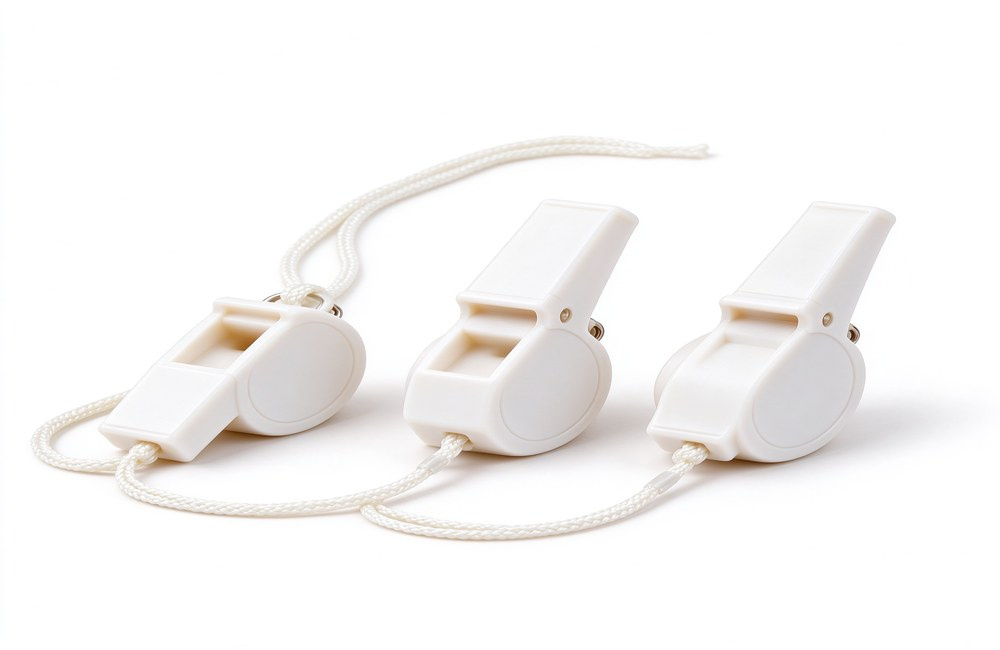
Three white emergency whistles with lanyards lined up on white background, emergency whistles bulk for the water safety equipment kit
Flood water turns streets into rivers in hours, and published drowning prevention guidance reports that drowning accounts for most flood disaster deaths.
The water safety kit moves with the household and the rescue team, because a flood response starts with the same layers: distance throwers, throw bags, whistles and flotation, and the kit is carried to the upper floor before the water arrives.
A household flood kit adds a throw bag and a whistle to the universal emergency kit, so a family on an upper floor can signal and throw a line to a neighbor below, and responders on the bank can reach a person in the current, so the flood kit turns a trapped family into a reachable family.
Marinas and coastal towns stock the same layers at scale before the storm season: line throwers on the piers, throw bags on the walkways, whistles on every jacket and lifebuoys on the racks. The storm drills run the same checklist as the summer drills before the season winds arrive.
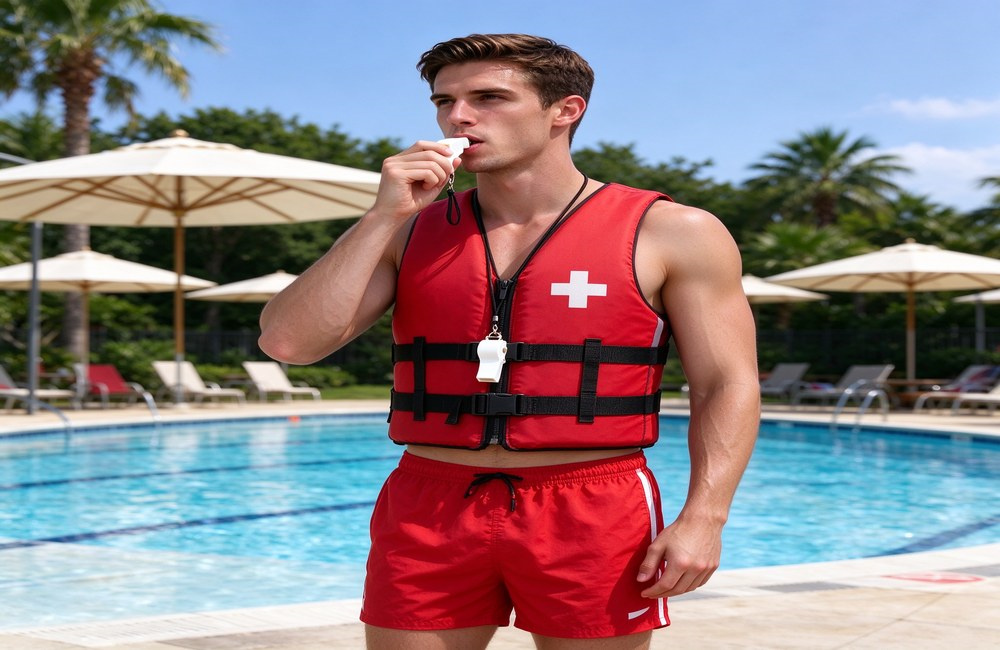
A foreign lifeguard blowing an emergency whistle at a swimming pool with a lanyard around his neck, emergency whistles bulk for pool and beach signaling drills
Rescue teams need gear that works in the dark, the cold and the current. The team kit combines the distance layer, the close-range layer and the signaling layer into one response set that every member can reach without a briefing, so the truck unloads in under a minute.
A response set holds one long-range line thrower, two throw bags, six whistles, four lifebuoys and spare rope, packed so one member carries the thrower and the others carry the bags and buoys.
The set covers a riverbank, a marina or a flood street the same way.
The set covers a riverbank, a marina or a flood street the same way, and the members rotate the roles so the thrower, the bag and the buoy are practiced by every person on the team.
Team buyers confirm the same points as every order: the rope pull strength, the bag buoyancy, the whistle sound range and the certificates.
On receiving, buyers check the stitching, the buckles and the packaging integrity, and the sample stays as the receiving reference for rescue throw bags wholesale, so the team order arrives exactly as the sample proved.
Teams drill quarterly and rotate the gear with the season: rope replaced after wet use, canisters refilled, whistles checked and lifebuoys inspected for cracks. The rotation log is the proof the response set was ready when the call came.
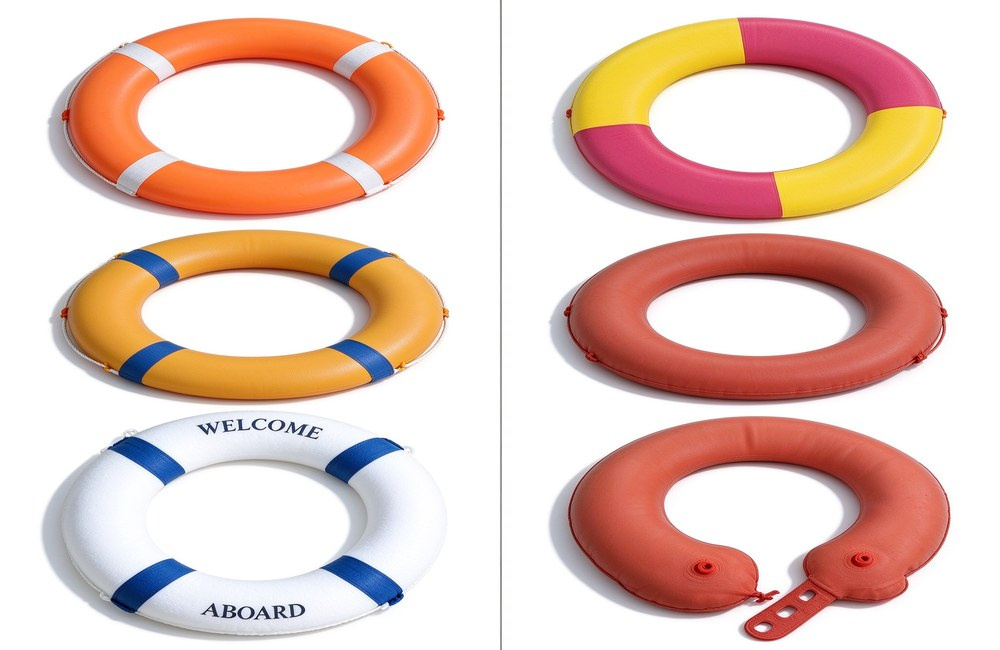
Comparison of six lifebuoy material types arranged in two columns on a white background, lifebuoys wholesale options for the water safety equipment buyer
A water safety order fails when the specs do not match the water. The confirmation checklist below is the ten-minute check every buyer runs before ordering, covering the distance, the rope, the buoyancy, the signaling and the documents.
The ten-minute check covers the throw distance, the rope length and pull strength, the bag capacity, the whistle type, the lifebuoy material, the certificates and the sample, and the same check runs twice a year with the seasonal restock.
Confirm the throw distance, the rope length and pull strength, the bag capacity, the whistle type, the lifebuoy material, the certificates and the sample. Published drowning prevention guidance keeps the same checklist grounded in prevention evidence.
The check covers the distance class, the rope pull strength, the bag buoyancy, the whistle tone and the buoy inspection, and the same checklist is used for the dock, the boat and the rescue team.
Certification language is written, not assumed: check the packing list, the material declaration and the applicable certificates, and keep the sample as the receiving reference. The documents are filed with the order, because the inspection and the audit review the same folder.
The declaration is read and filed, the packing list is counted against the cart, and the applicable certificates are matched to the products, so the buyer does not repeat a certification that the document does not state.
| Order step | What to confirm | Document | Receiving |
|---|---|---|---|
| Sample | Throw distance, rope pull | Sample record | Keep as reference |
| Bulk run | Rope specs, bag count | Packing list | Match sample |
| Certificates | Applicable certificates | Declaration | File with order |
| Delivery | Cart count, condition | Delivery note | Inspect every cart |
The table above is the supplier confirmation list: the columns show the order step, what to confirm, the document and the receiving check.
Marina, school and rescue team buyers use the same columns when they order bulk rescue line throwers, rescue throw bags wholesale and emergency whistles bulk.
The document column is the paper trail the buyer files with the order, and the receiving column is the comparison the buyer runs at the delivery door.
Near-water incidents escalate in seconds, and the right water safety equipment changes the outcome before the alarm even sounds.
Good water safety equipment is mounted, inspected and drilled, so the response is automatic.
Every dock, boat and pool should post the same water safety equipment checklist, and the water safety equipment list is refreshed each season.
The same water safety equipment standard applies to home docks and rescue fleets.
Our rescue line throwers and whistles guide and bulk water rescue supplies help buyers close these gaps before a swimmer needs help.
The same drowning prevention gear applies at home and at the beach, and every drowning prevention gear drill starts with a mounted throw bag.
Dock and marina operators need lifebuoys, throw bags and whistles along every slip as part of their aquatic safety kit.
Each aquatic safety kit is mounted at the point of use, and the aquatic safety kit contents match the dock layout.
Vessels need PFDs, a throwable device and a whistle on board. We supply lifeguard safety equipment and boat kits at fleet scale.
Pool and beach staff need rescue buoys, throw ropes and signaling whistles. We supply consistent bulk water rescue supplies for lifeguards.
NGOs and fire departments need scaled flotation, throw bags and dry bags. We supply a water rescue throw bag supplier range with packing lists, samples and fleet orders.
Each water rescue throw bag supplier order ships with a sample and packing list.
Throw bags and whistles must be mounted, not tucked in a cabin. Mount them at the point of use before the season starts.
A short line never reaches a swimmer. Choose a throw distance that matches your waterway, not the smallest bag on the shelf.
Voice carries poorly over wind and water. A whistle and a light make the signal heard and seen at distance.
Lifebuoy ropes fray and buoy cracks grow. Inspect monthly and restock after any use or storm season.
Choose the kit by setting and crew size. The table below matches each kit to its use.
|
Kit setting |
Best for |
Core contents |
Typical buyer |
|
Dock kit |
Docks and marinas |
Lifebuoy, throw bag, whistle |
Marinas |
|
Boat kit |
Vessels and fleets |
PFDs, throwable, whistle, light |
Boats |
|
Pool kit |
Pools and beaches |
Rescue buoy, throw rope, whistle |
Lifeguards |
|
Flood kit |
Flood response teams |
Flotation, dry bags, signal |
Rescue teams |
Pair the kit with lifeguard safety equipment matched to the setting on site, and order the same aquatic safety kit for every dock, boat and pool so the reach-or-throw response stays identical across all your water sites.
The matched aquatic safety kit keeps the response identical across sites, and every aquatic safety kit is inspected monthly.
Use this quick-response timing table alongside the kit choice.
| Step | Action | Target |
|---|---|---|
| Spot the swimmer | Shout for help, reach or throw | Seconds |
| Deploy throw bag | Bag the line, lead the flotation | Within reach |
| Signal | Whistle and light, mark the spot | Continuous |
| Recover and restock | Reflake, rinse, dry | After use |
Drill these spot, deploy, signal and recovery steps each season with the throw bag and whistle in hand, so responders move without thinking and the lifebuoy line is ready the moment a swimmer calls for help.
Basic care keeps every piece ready for the next rescue.
We supply all of the above as bulk water rescue supplies for wholesale and OEM. Every order follows the same water safety equipment checklist.
Orders over 200 sets can be private-labeled; MOQ and lead time are per contract, and the water safety equipment list stays consistent across the fleet.
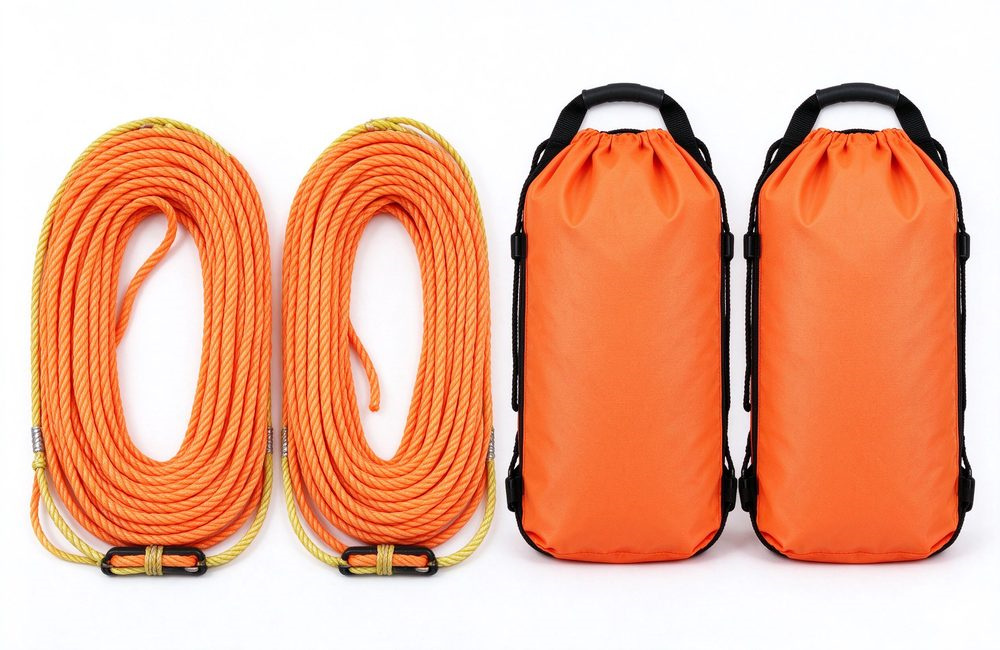
A rescue line thrower for distance, rescue throw bags for close range, emergency whistles for signaling, lifebuoys for flotation and a waterproof storage bag, sized to the dock, boat or rescue team. The same layers cover a family dock and a marina with the quantities scaled to the reachable posts.
Portable units reach about 80 meters for water and 110 meters on land, while long-range systems reach 230 meters with a rope pull strength above 2000 newtons. The distance is matched to the water: a marina needs the portable class, a rescue fleet needs the long-range class.
A line thrower sends a rope 80 to 230 meters using compressed air, for victims beyond arm or toss range. A throw bag covers 20 to 30 meters with one toss, for the close-range rescue where the responder stays on the bank. Most kits carry both.
One whistle per person on a lanyard, plus one spare per boat or dock station. Teams buy emergency whistles bulk because the same whistle works for pool drills, dock patrols and boat checks, and the spares cover the lanyards that break in a season.
Plastic and PU suit pools and calm docks, foam and EVA suit lakes and schools, rubber suits marine and coastal use, and horseshoe buoys suit rescue reels. Lifebuoys wholesale orders mix the types so the dock, the boat and the station each have the right ring.
In an open kit box with the label facing out, one step from the water edge, with the throw bag in a quick-release holder and the whistle on a lanyard. The line coils free so nothing tangles, and the dates are checked with the seasonal restock.
Quarterly for air systems and cinch bags, and after any wet deployment for rope. Rope is replaced after wet use because wet rope weakens, and the next launch may be the one that matters.
A throw bag floats and the rope floats, so the swimmer can grab the tail even in current, but the responder should tie the bag end to a fixed point when the current is strong. The bag keeps the rescue on dry ground while the victim holds the line.
Yes. A boat kit covers jackets, throwables, whistles and a first aid pouch for the vessel, while a dock kit covers throw bags, lifebuoys and a line thrower for the shore. Both follow the same confirmation checklist before the season opens.
Reach or throw, do not go: the responder stays on the bank and uses a reach pole, a throw bag or a line to help the victim, because a responder who jumps in becomes a second victim. The Red Cross teaches the same rule in its water safety guidance.
A packing list, material declarations and applicable certificates, with one assembled sample as the receiving reference. Confirm the rope pull strength, the bag buoyancy and the whistle type, and file the documents with the order for the audit.
Yes. Marinas, schools and rescue teams order bulk rescue line throwers, rescue throw bags wholesale and emergency whistles bulk with the same confirmation checklist and the same sample reference. The sample stays on the shelf and every delivered cart is compared against it.
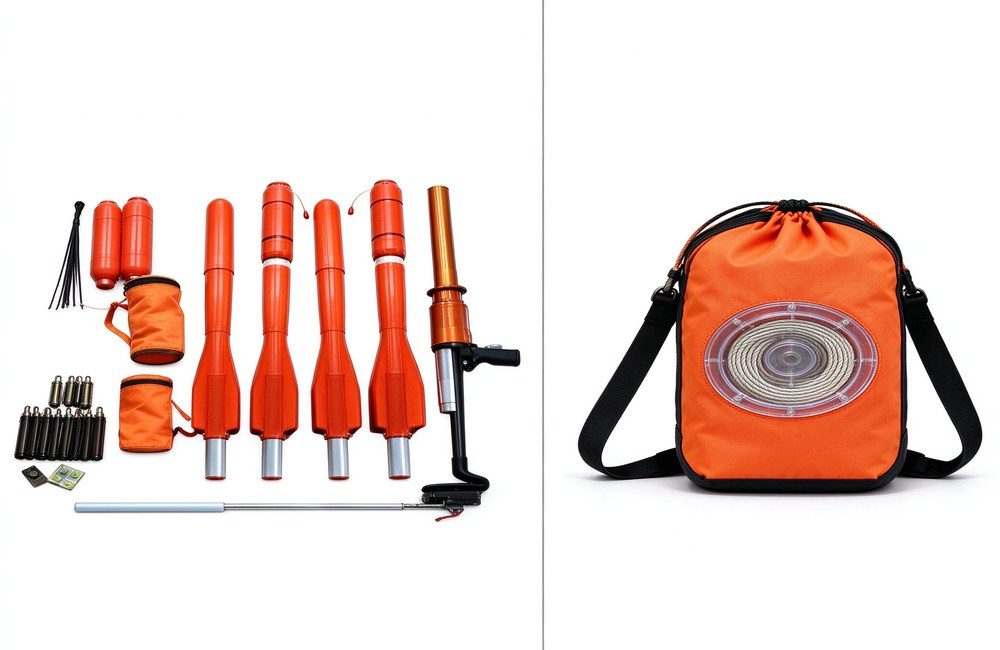
The water safety kit is one layer in a complete preparedness plan. Pair it with the universal emergency kit checklist, which covers water, food, first aid and lighting for every season, and keep the water-specific layers on top.
The universal checklist holds the water, food, first aid and lighting that every emergency needs, and the water safety kit adds line throwers, throw bags, whistles and lifebuoys, so the two boxes answer a flood week and a storm week from the same shelf.
Review the water safety kit twice a year with the seasonal restock: check the rope, the canisters, the whistles and the buoy cracks, and confirm the contact list. The same review rhythm refreshes the universal kit, so the whole preparedness plan stays ready.
The same review rhythm refreshes the universal kit, so the whole preparedness plan stays ready when the flood week and the storm week arrive in the same season.
The quarterly walk checks the dates on both kits, replaces the used items and confirms the contact list, so the preparedness plan stays current across the whole season and the dock never enters a peak with a half-used kit.
Pautan Mesra :
hak cipta © Custom Disaster - Relief Bedding: Tents, Sleeping Bags, Blankets Hak cipta terpelihara
pasukan profesional untuk perkhidmatan !