Kategori
Last updated: October 28, 2026 · YRF Emergency Preparedness Team
Buying field cold weather blankets in bulk is not the same as stocking a warehouse: a field program must balance volume, lead time, GSM and transport weight, and one shipment against scheduled lots. This guide walks through the numbers a procurement team should pin down before placing a bulk blanket order, so the blankets arrive ready for the mission.
Certification files have an expiry date. Check the report date, not just the name: an expired safety report does not protect a new order, so ask in the RFQ for documents with a current validity period. Institutional and military buyers often require written compliance files, and asking for them at the RFQ stage instead of after the order keeps the project on schedule.
Common documents include textile safety reports, flammability test results, origin declarations and factory audits. Do not assume one certificate covers every requirement: safety, flame resistance and origin are separate documents, each taking time to obtain. Request the list at the RFQ stage, then decide on the supplier.
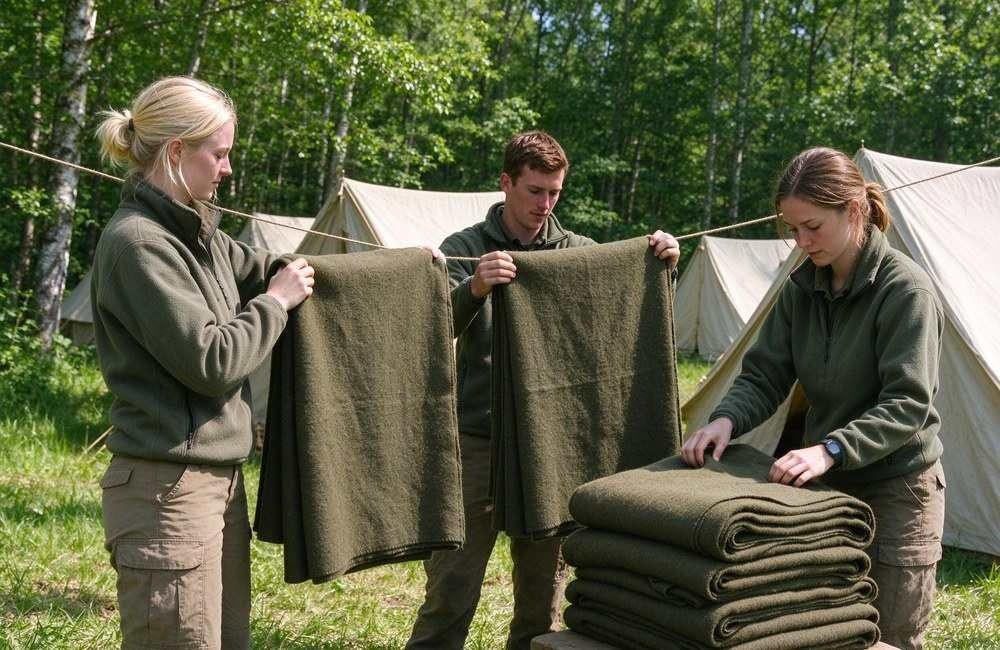
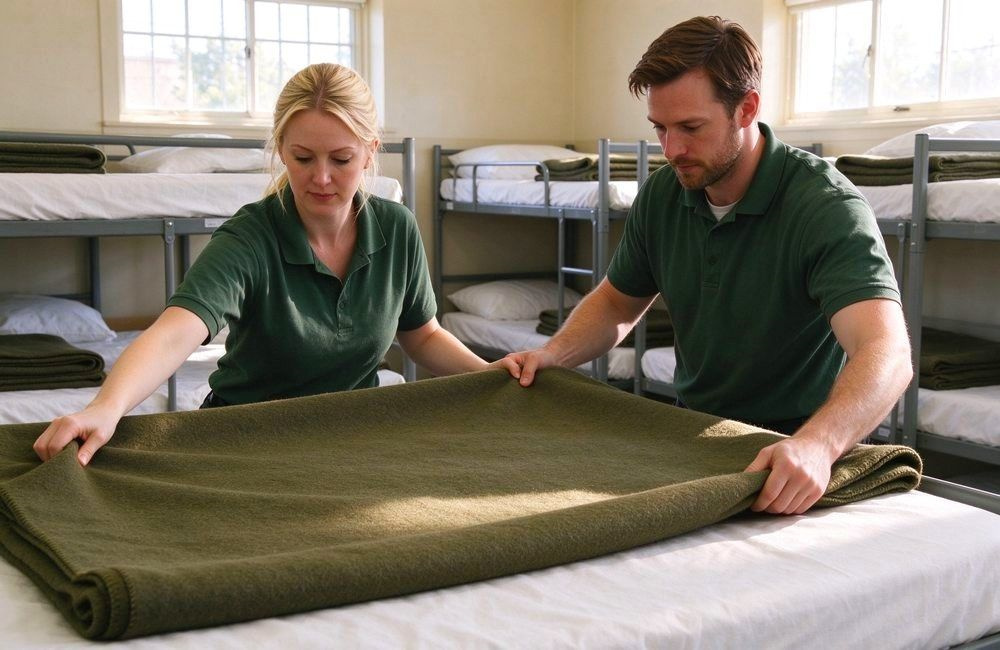
Field workers air and fold olive wool blend blankets at relief camp.
A complete RFQ turns the mission brief into comparable quotes. Without it, each supplier answers a different question. Send the same RFQ in writing to every supplier, with the same fields, and ask for written replies, because written replies form the comparison table and the procurement record.
Include the acceptance criteria in the RFQ, not after the order. Suppliers who know the inspection rules quote and deliver to them. Put the shipping date in the RFQ so suppliers can quote an honest schedule: buyers who hide the deadline receive optimistic quotes and late shipments, while buyers who state the date get a workable plan or an early reason to change supplier.
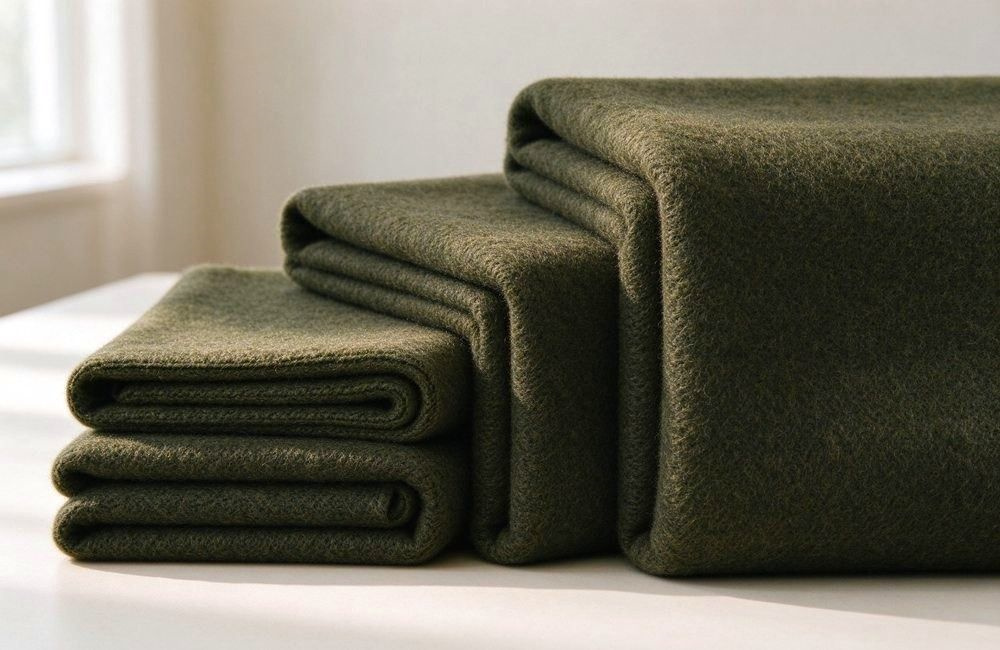
Field blankets are ordered in hundreds and thousands of pieces, not dozens, because a single incident can need blankets for an entire shelter population overnight. At that scale the unit price drops, but the risks change shape: fabric weight, packing, labelling and transport now matter more than the per-piece price.
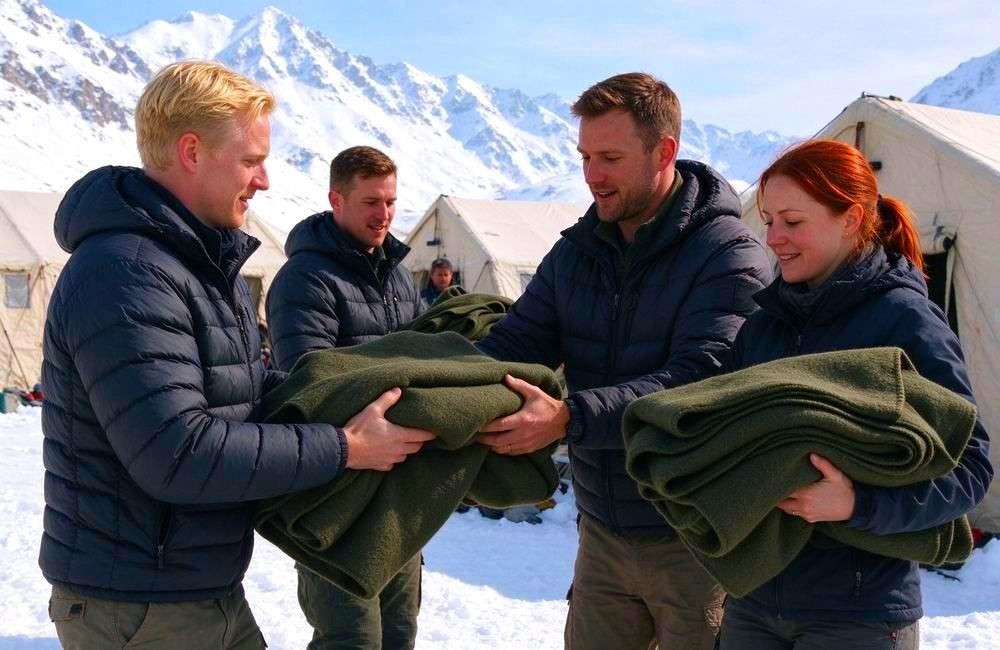
Rescue team handing out olive wool blend blankets at snow mountain camp.
Blankets sized for the mission travel by the route the mission allows.
The teams that buy well start by describing the mission, then let the mission set the blanket spec, the quantity and the delivery rhythm. The rest of this guide walks through each written decision in the order it comes up, so nothing gets approved on feel alone. Two buyers ordering the same blanket for different missions will often end with different GSM, different sizes and different shipment plans — that is normal, not a mistake.
The core rule is simple: never separate the blanket from the task it will perform. A 600 GSM blanket that is perfect for a mountain rescue cache is too heavy to ship by air to a flood zone. A light 150×200 cm blanket that works for a warm-climate shelter can fail in a winter field camp.
Once you fix the task, the size, the GSM and the quantity all fall out of that single decision — which is why the first sections of this guide are about the mission, not the fabric. A common shortcut is to copy a neighbour program's spec, but the copy rarely fits a different climate, different population or different transport route. Start from the task sheet instead: temperature range, night count, transport mode and storage space. Four lines, four answers.

This article keeps the same structure as a field logistics brief: baseline first, users second, readiness checks third, then samples, then the one-shipment-versus-scheduled-lots decision. Each section ends with a number you can put into an RFQ, so the final document can be sent to a supplier almost as-is. That is what makes bulk procurement defensible — the numbers are written down before anyone signs, and the same file answers the auditor's questions later. If a section does not apply to your program, skip it and come back next season — the format stays the same, so the second order takes half the time of the first.

Read the whole guide once, then jump to the section that matches where you are. If you are still defining quantities, start with the baseline and user-count sections. If the specification is already fixed, skip to samples and the shipment decision. Either way, the tables and checklists below are designed to be copied into your own spreadsheet and reused for the next program, so the second order takes half the time of the first. Each table is kept to four columns and a handful of rows, so it reads cleanly on a phone during a field review. Most teams keep one master file per product family, and each new order adds a row rather than starting from scratch. That habit alone removes most repeat negotiations, because the baseline is already written down. It also means a new buyer can pick up the file and answer the same questions without a handover meeting.
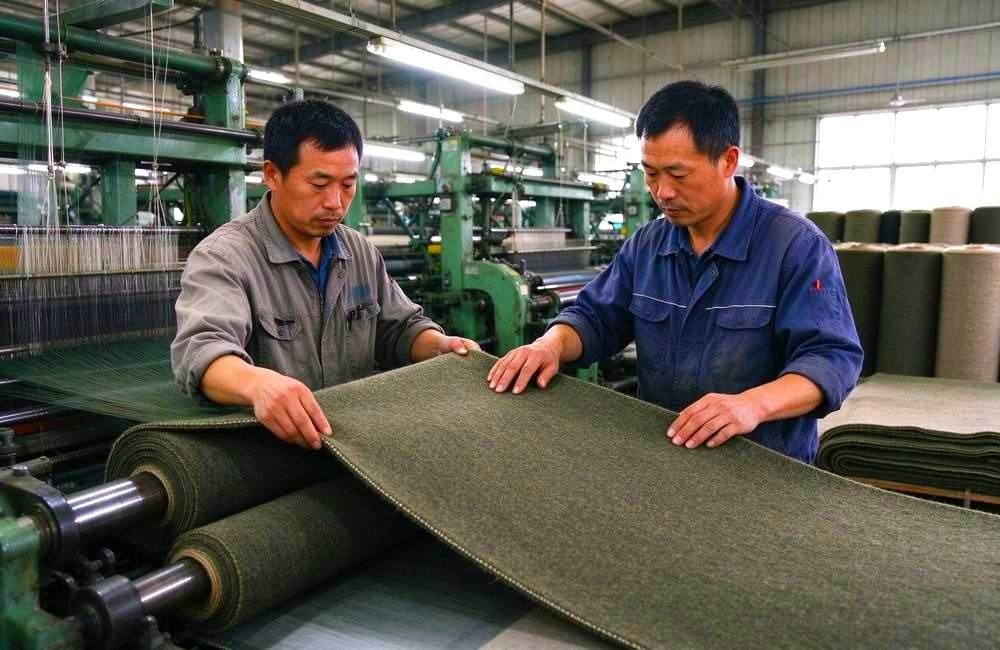
Weavers check olive wool blend blanket fabric at weaving looms.
One more thing before the details: field buyers are rarely buying for themselves. They buy for a shelter, a relief organization, a military logistics unit or a municipal stockpile. That means every decision has to survive review by another buyer, an auditor or a budget committee. The discipline in this guide is aimed at producing a paper trail — baseline data, user counts, readiness checks, sample records and shipment logic — that any second reader can follow without being a textile expert. That paper trail also makes handover easy when a new buyer takes over the program mid-season, because nothing lives only in one person's head. When the file is complete, the order can move between agencies, warehouses and seasons without losing its reasoning, which is exactly what an auditor looks for.
The good news is that the decision does not need to be complex. With the right fabric spec, a clear user count and a realistic delivery window, a bulk order for wool blend blankets for field use becomes a routine procurement task. The sections below break that routine into steps you can execute today. Even a first-time buyer can follow it: answer three questions about the task, lock three numbers in the spec, and let the supplier quote against the same file, so every quote is compared on identical terms. The checklist at the end of the guide turns those steps into a one-page gate that any team member can run before the order goes out, and it takes about ten minutes to run.
If you came here because a field program is already short on blankets, start with the quantity sections and skip the theory. If you are planning next season's stock, read the full guide and use the readiness checklist to time the order. Either way, the numbers below come from standard textile practice: GSM is fabric weight per square meter, finished weight is what the packed blanket weighs, and the difference between them changes transport cost. Use the short checklist at the end of each section as a gate before moving to the next decision. Working through the sections in order, then re-running the checks once on the finished file, is the fastest route to an order that survives review and arrives on time. The same file then works as the record for the next season's order.
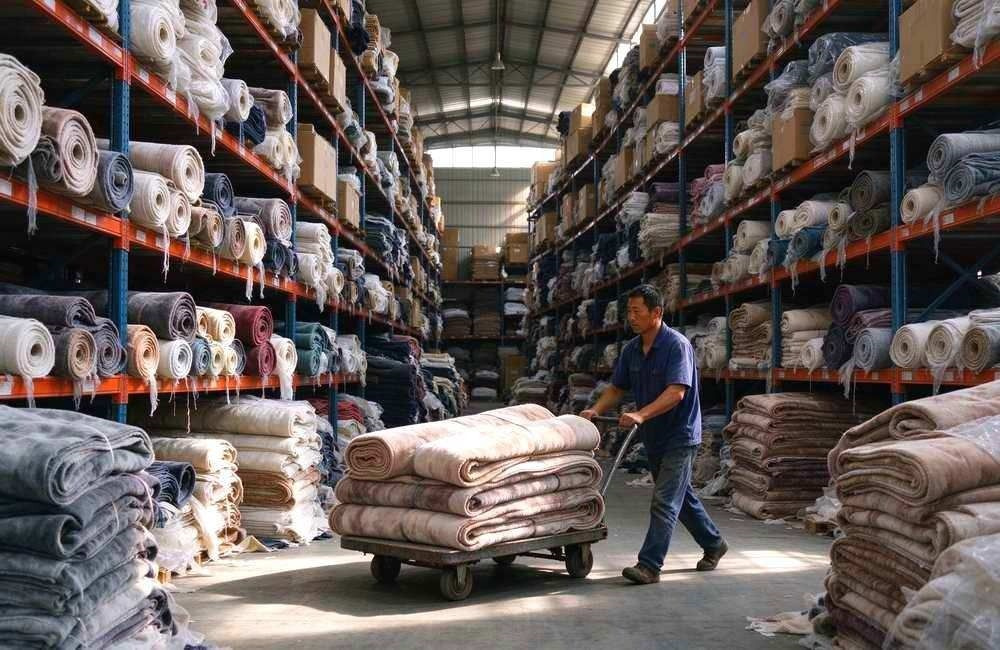
Worker transports wool fabric rolls by trolley in textile warehouse.
Every bulk order begins with a mission description, because the mission decides the fabric, the size and the quantity. A winter field exercise in a mountain region needs heavier blankets with a higher GSM and a tighter weave. A flood-relief shelter in a warm climate needs lighter blankets that pack small and dry fast. The same supplier can make both, but the spec sheets will look very different.
Start the plan with the mission and the numbers will follow. A blank page is the enemy: every field team that orders blankets from memory ends up renegotiating the same questions next season. Writing the mission down also exposes gaps early, such as missing transport capacity or an unconfirmed arrival date, while they are still cheap to fix.
Write the mission down as three lines before contacting any supplier: where the blankets will be used, when and for how long, and how cold it gets. These three lines answer more questions than any price list — they set the GSM band, the size range and the storage plan.
Price should be the last filter, not the first. If a cheaper blanket fails in the field, the real cost is the mission failure, not the unit price. Buyers who start with price usually reorder twice: once for the cheap batch that underperforms, and once for the spec they needed in the first place. Starting with the mission avoids that double spend.
The mission also decides the ratio of sizes. A shelter program usually needs mostly 150×200 cm blankets with a smaller share of larger 180×220 cm pieces for family bedding. A military cache might invert that ratio. State the expected size split in the RFQ, because the cutting plan and the price per piece change with the mix.
A written mission also protects the budget. When the requirement is on paper, a cheaper alternative has to prove it meets the same task, not just a lower price. That discipline filters most wrong specs before they reach a supplier, and gives the team a reference point for every later decision.
GSM means grams per square meter and describes the fabric density. Finished weight means what one blanket weighs when packed, including seams and binding. The two are related but not identical — mixing them up is a common cause of wrong transport and storage plans.
For a standard field blanket in 30% wool and 70% polyester, the practical GSM band runs from 600 to 1000. At 600 GSM the blanket is lighter and packs smaller, which suits transport-heavy missions. At 800 GSM it balances warmth and weight for most winter programs. At 1000 GSM it is the heaviest option, built for extreme cold and long-term field use where warmth outweighs transport cost.
Convert GSM to finished weight with a simple formula: GSM times the blanket area in square meters, plus a small allowance for binding and seams. For a 150×200 cm blanket the area is 3.0 square meters, so 600 GSM gives roughly 1.8 kg, 800 GSM gives roughly 2.4 kg, and 1000 GSM gives roughly 3.0 kg. For a 180×220 cm blanket the area is 3.96 square meters, so the same GSM band gives roughly 2.4, 3.2 and 4.0 kg.
Write both numbers — GSM and finished weight — into the RFQ and the sample record. If suppliers quote different finished weights for the same GSM, ask how seam allowance and binding are calculated. A 0.1 kg difference per blanket changes the freight bill by a full pallet on a large order.
The brushed surface also matters: raised fibers trap a still layer of warm air against the body. Run a hand across the sample under daylight — the nap should be even, dense and soft, not flat or patchy. Ten seconds prevents a batch that feels wrong in the field.
A useful habit: keep a one-line record per order — GSM, finished weight, transport mode. Over several programs that small table becomes the fastest estimator for the next mission, read straight off without redoing the arithmetic.
The weight table is a planning tool, not a promise: finished weight varies with weaving tolerance and finishing, so weigh the production sample and update the table before freight is booked.
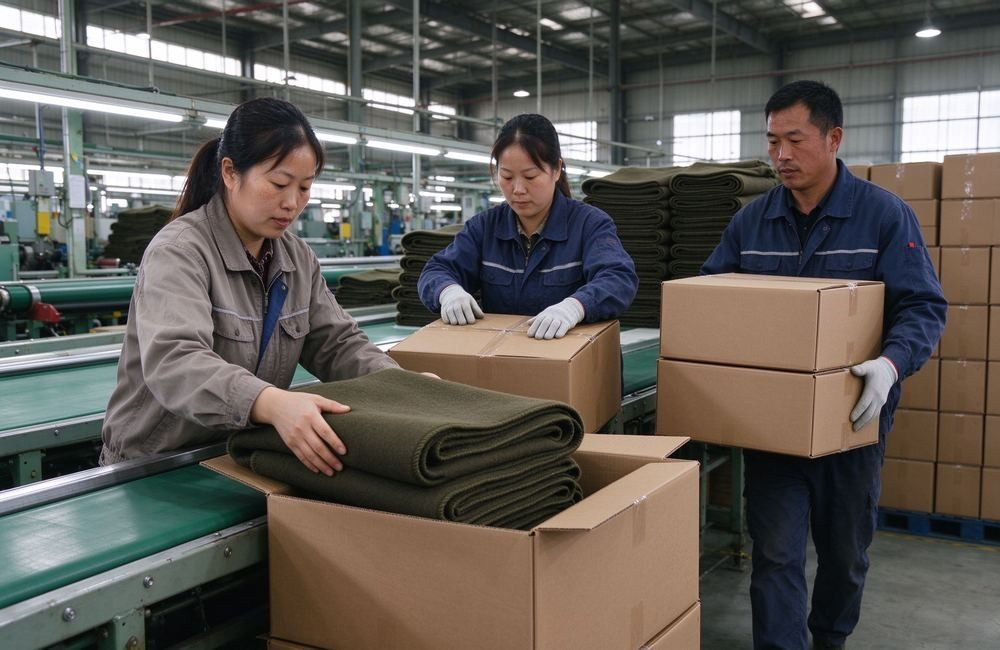
Workers pack wool blend blankets into cartons on production line.
The most common quantity error in field blanket procurement is counting total staff or total registered population instead of simultaneous users. A shelter may serve 2,000 people across a season, but only 400 people sleep there on any given night. Ordering 2,000 blankets leaves 1,600 pieces sitting in storage while the nightly shortfall is real.
Collecting these numbers takes less than an hour: peak night, reserve rate, size split, GSM and delivery window. One page turns a vague request into an orderable specification.
Define the peak night: the highest number of people needing a blanket at the same time in the same place — shelter occupancy at full capacity, sleeping positions in a field camp, or vehicles times crew for a cache. Only the peak-night number belongs in the order.
Add a reserve of 10 to 15 percent on top of the peak count for loss, damage and unexpected arrivals. A 400-bed shelter therefore orders 440 to 460 blankets, not 2,000. State the count, the reserve and the final quantity in the RFQ, so the arithmetic is visible to any second reviewer.

Forklift loading palletized wool blanket cartons into container.
Field programs rarely need a single spec. Different tasks inside the same program call for different sizes and weights, and the mix should be planned, not improvised. The table below maps the common field tasks to a practical spec, based on standard wool-blend blanket practice.
|
Field task |
Recommended size |
Recommended GSM |
Why it works |
|
Shelter bedding (indoor) |
150×200 cm |
600–800 |
Balances warmth with wash-and-reuse durability |
|
Cold-weather field camp |
180×220 cm |
800–1000 |
Extra coverage and warmth for exposed conditions |
|
Vehicle / mobile cache |
150×200 cm |
600 |
Light weight keeps the cache payload low |
The size choice follows the sleeping arrangement. Individual cots take a 150×200 cm blanket comfortably. Family bedding in a shelter needs the larger 180×220 cm size to cover two people. Vehicle caches favor the smaller size because every kilogram of stored blanket competes with other cargo.
Colour is a specification, not decoration. Field programs usually lock a single functional colour — deep olive green is the common default because it hides soiling and blends into field environments. If the program needs multiple colours, confirm the split with the supplier before production, because dyeing each colour has a minimum batch size and affects the price per piece.
Send the exact dimensions, the GSM band and the colour reference in the RFQ. Ambiguous specs invite substitutions at the supplier side, and substitutions in field equipment are exactly what a review board rejects. The more precise the RFQ, the fewer surprises at sample stage.
Season timing also belongs in the spec. A shelter program that runs all year may order the same blanket in every season, while a winter-only program should place the order early in the year and receive stock before the first freeze. Write the season into the RFQ alongside the size and GSM, so the supplier plans production against the real deadline rather than a guess. Add two weeks of buffer for customs and weather, and put the date in the order file so every later check refers to it. When the arrival date moves, the review date moves with it, which keeps the whole plan honest.
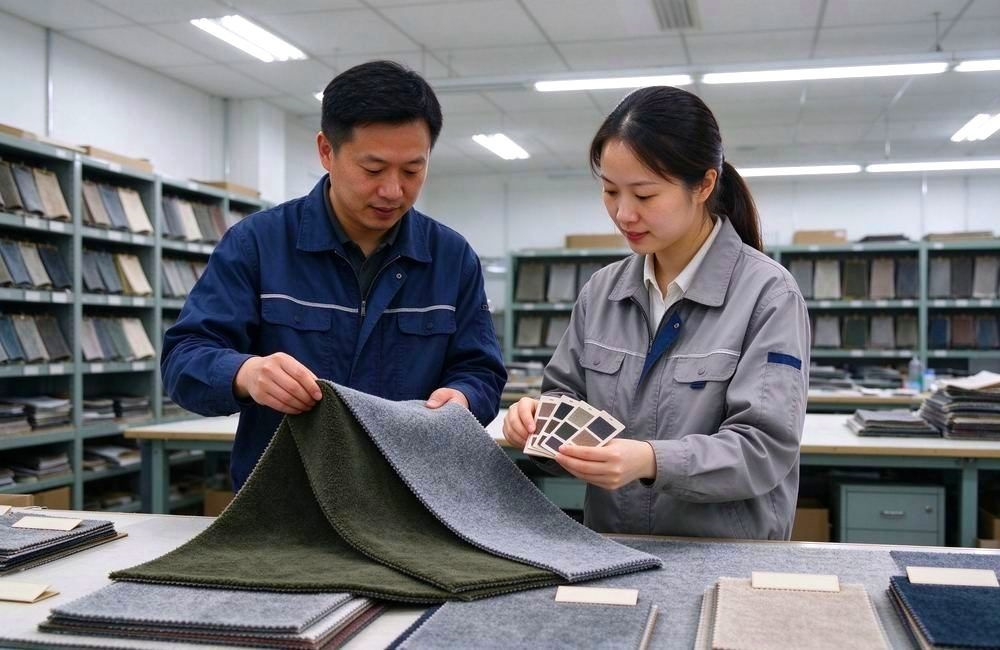
Before committing to a bulk order, run six readiness checks. Each check is a yes-or-no question, and a single no means the order is not ready. This gate protects the program from ordering the right spec at the wrong time.
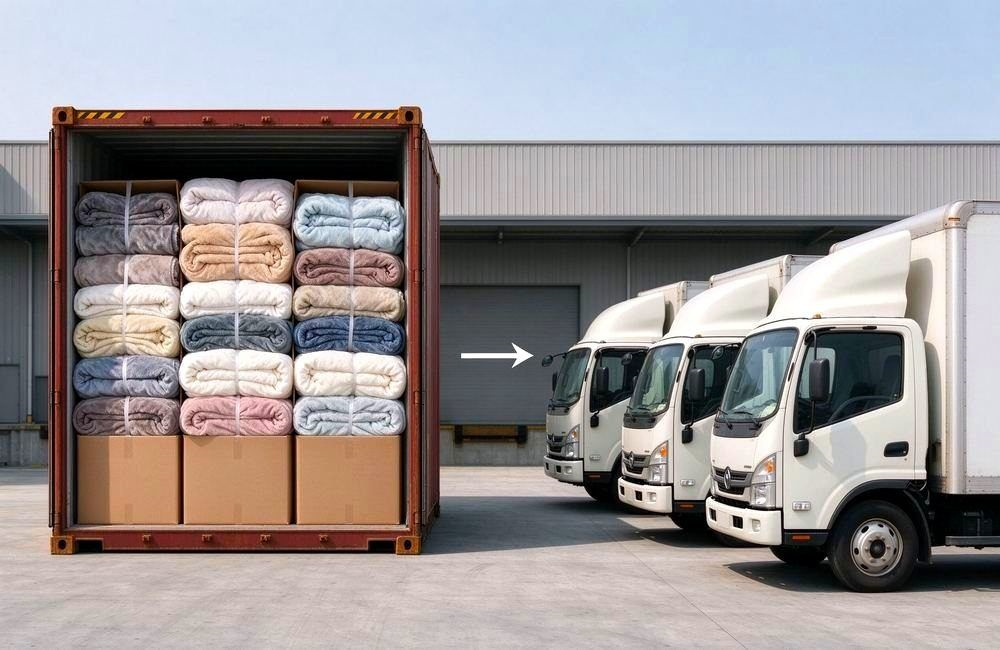
Comparison of one full shipping container versus scheduled truck deliveries for bulk
The six checks: peak-night count with reserve written down; size and GSM locked with an approved sample; delivery matched to the season; packing defined with bale size, carton weight and labels; storage dry and ventilated; budget confirmed at the quoted price.
Run the checks in order and stop at the first no. Fixing the missing item usually takes less time than rescuing an order that was placed too early. Teams that skip the checks end up storing blankets they cannot distribute, or distributing blankets that do not match the task.
Keep the checklist with the order file. When the review board asks why the quantity is what it is, the six checks are the answer. The checklist also becomes the template for the next program, so the second order goes through faster than the first.
A practical way to run the checks is to put them in one short RFQ cover note: quantity basis, spec basis, delivery window, packing, storage and budget. The supplier answers the same six lines, and the comparison between quotes becomes fair because every quote answers the same questions. This also makes the review stage faster, since the six answers line up side by side. When a quote fails one line, ask the supplier to correct it in writing rather than assuming it was a typo — a missing storage or packing answer usually hides a cost that will surface later.
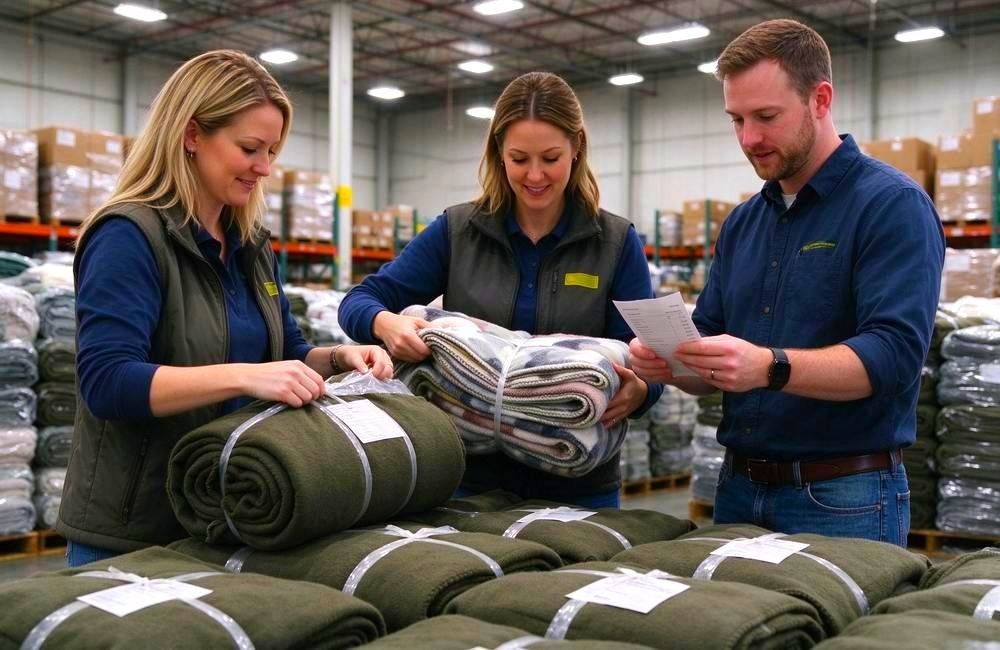
A sample is the cheapest insurance in bulk procurement. Ordering thousands of field blankets on the strength of a brochure photo is how programs end up with the wrong GSM or the wrong shade. The sample-first rule is simple: approve the physical sample before any production commitment.
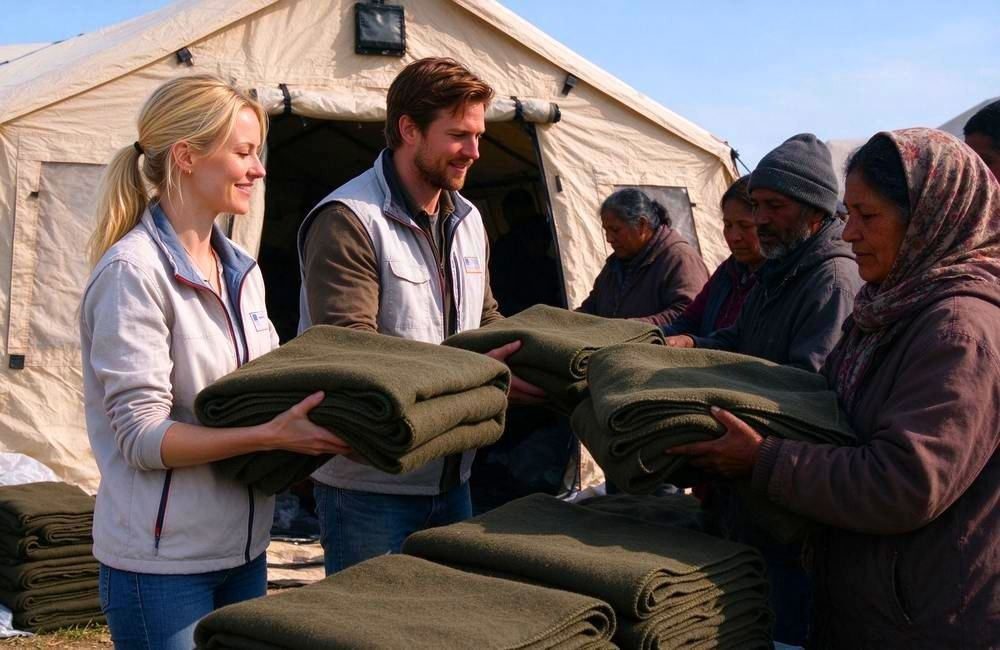
Relief team handing out wool blend blankets at disaster camp.
Request three things with the sample: the swatch in the exact colour, the finished blanket in the exact size, and the weight certificate showing GSM and finished weight. Check all three under daylight. Compare the shade against the reference, feel the nap, and weigh the blanket on a normal scale to confirm the arithmetic from section two.
For large programs, add a pilot lot of 100 to 500 pieces before the main production. The pilot confirms three things the sample cannot: how the blanket sews at production speed, how it packs into the cartons, and how it survives transport to the destination. A pilot lot is a small, fast batch that reveals the issues a single sample hides.
Record the sample approval in writing: the date, the approved GSM, the finished weight, the colour reference and the name of the approver. When the full order arrives and a dispute appears, that record is the baseline. Sample records also stop specification drift on repeat orders, because the supplier knows the approved spec is on file.
Timing the sample matters too. Request the sample at the same time as the pilot lot is planned, so the sample approval and the pilot production run back to back. That saves a full cycle of waiting, and it keeps the approved spec fresh in the production team's hands when the pilot starts.

Close-up texture of brushed wool blend blanket fabric.
After the quantity is fixed, the next decision is delivery structure: one full shipment or several scheduled lots. Each option fits a different mission profile, and the right choice depends on how fast the program needs stock versus how much it can store.
One shipment works when the destination can store the full volume at once and the season window is short. It wins on freight per piece but concentrates risk: one delay hits the whole program.
|
Decision factor |
One full shipment |
Scheduled lots |
|
Storage capacity |
Needs large dry space at destination |
Spreads stock across several deliveries |
|
Cash flow |
One large payment up front |
Payments spread over the schedule |
|
Risk exposure |
Single point of failure |
Issues found in lot one are fixed before lot two |
|
Typical use |
Seasonal surge or one-time event |
Ongoing programs and staged build-up |
Scheduled lots fit programs that build stock gradually or destinations with limited storage. Smaller lots lower the storage burden and spread the budget, and each lot becomes a checkpoint before the next leaves the factory.
State the delivery structure in the RFQ and confirm the lot dates in writing. A clear schedule is what separates a planned program from a reactive scramble. Whatever structure you choose, keep the same spec across lots, because mixed specifications across deliveries are hard to manage in the field.
When the shipment structure is decided, write the logic into the order record: why one shipment or why lots, what each lot contains and when it arrives. That record answers the review question later, and it also becomes the template for the next program's delivery plan.

Workers loading emergency blanket cartons, European inspector checking shipment list.
Transport cost is a hidden driver of the bulk blanket decision, because finished weight, not piece count, determines the freight bill. A 600 GSM blanket at roughly 1.8 kg is meaningfully lighter than a 1000 GSM blanket at roughly 3.0 kg, and across thousands of pieces that difference is several tonnes. If the mission involves air freight, weight per piece should be weighed as seriously as warmth.

Storage planning starts before the order, not after arrival. Field blankets must stay dry, ventilated and off the floor. A damp warehouse can ruin a whole batch before it ever reaches a shelter. Confirm the storage space, the pallet layout and the rotation method as part of the readiness checks, and verify the space can actually hold the ordered volume.
Distribution planning covers the last mile: how the blankets move from the warehouse to the users. For shelters, plan the issue point and the record-keeping at distribution. For field camps, plan the vehicle loading sequence so blankets are accessible on arrival. A distribution plan prevents the common failure where blankets arrive at the destination but cannot be issued quickly.
Record the transport details with the order: total weight, pallet count, carton count and the freight terms. When the shipment arrives, check the cartons against the packing list before signing. Catching a shortfall at the dock is cheap; catching it after distribution has started is expensive.
Transport planning also benefits from a simple weight check at the sample stage. Weigh the sample blanket, multiply by the planned quantity, and compare the total with the available freight capacity. This five-minute calculation prevents ordering a spec that physically cannot move on the planned route.
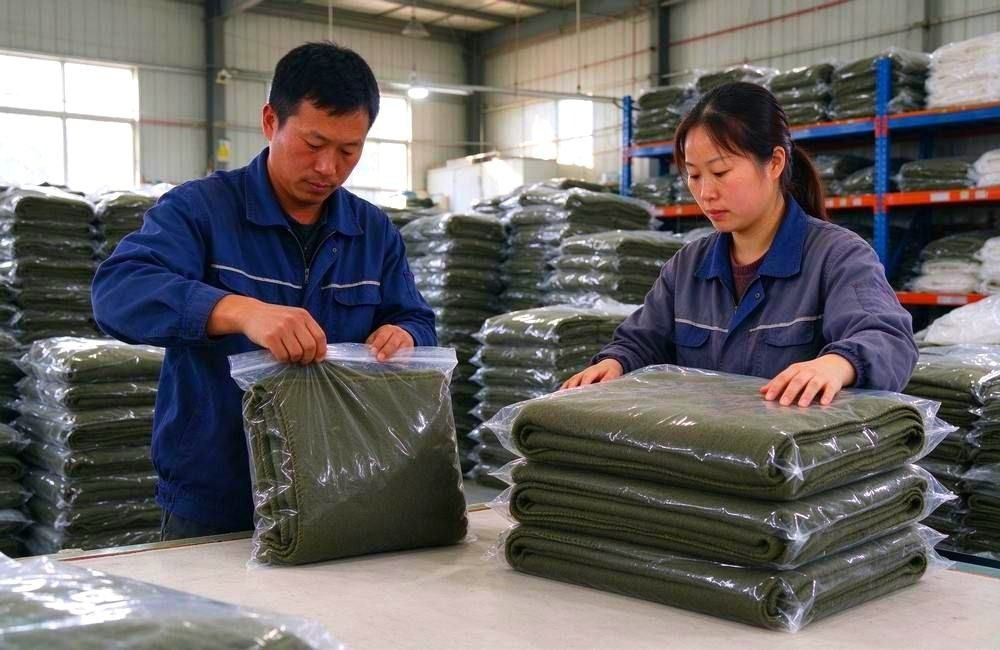
Packing is part of the specification, not an afterthought. Field programs need to know exactly what is inside each carton — how many blankets, what size, what colour, what weight — because that data drives both distribution and restocking. Record it before production so the supplier packs to the same standard.
A practical packing standard for field blankets is a bale or carton of 10 to 20 folded pieces, with the blanket count, size, GSM and colour printed on the label. The carton weight should stay within a range the field team can handle, because oversized cartons create injuries and handling delays at the destination.
Label each carton with the same data you will record in the stock system: product code, quantity, size, GSM, colour, production date and batch number. Consistent labelling is what makes rotation possible — the field team can issue the oldest batch first and keep the stock fresh.
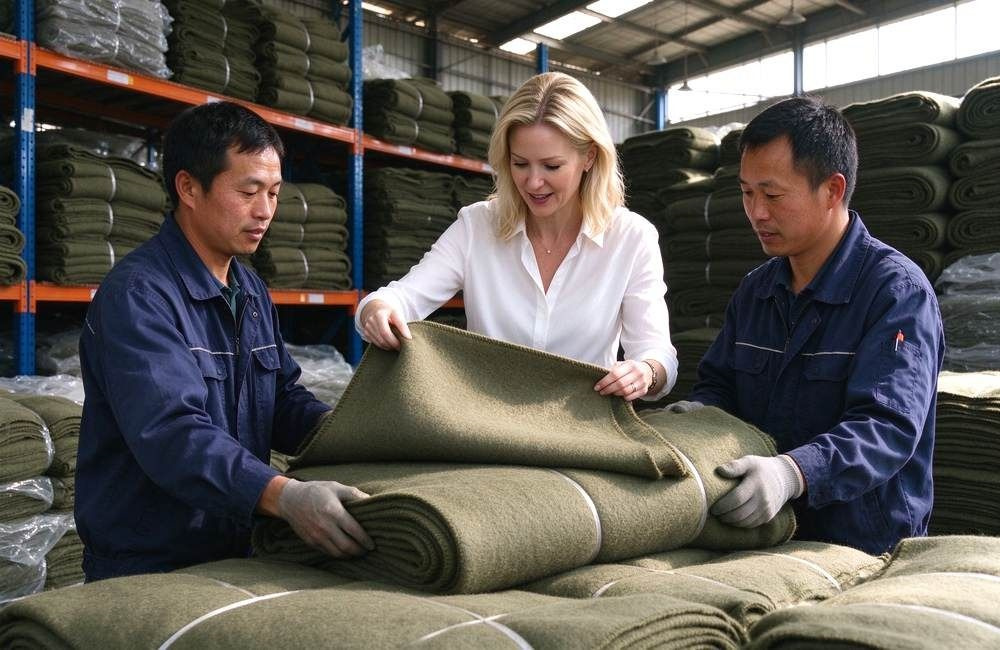
European buyer inspects wool blend emergency blankets with factory workers.
Verify the packing before shipment, not after. A standard pre-shipment check covers the carton count, the label accuracy and a random carton opened to confirm the contents. Request this check in the RFQ and confirm the result in writing. A verified packing record is exactly what a receiving team needs to sign off the order cleanly.
Blanket spec
150×200 cm finished weight
180×220 cm finished weight
600 GSM wool blend
≈ 1.80 kg
≈ 2.38 kg
800 GSM wool blend
≈ 2.40 kg
≈ 3.17 kg
1000 GSM wool blend
≈ 3.00 kg
≈ 3.96 kg
The weight table above is a planning tool: use it to estimate freight and storage before the samples arrive, then replace the estimates with the measured weights from the approved sample. Keeping the planning numbers and the measured numbers side by side makes the final transport decision transparent.
A fifth mismatch appears at distribution: labelling that does not match the issue plan. If the field team cannot tell the sizes apart from the labels, the wrong blankets go to the wrong beds. The fix is the packing standard from section nine, applied consistently from the carton to the issue point.
Most field blanket order failures come from a small set of mismatches, and all of them are avoidable at the specification stage. The first is the GSM-versus-weight mismatch described earlier: ordering a blanket that feels right in the hand but is too heavy to move at scale. The fix is to write both numbers into the RFQ and verify them on the sample.
The second mismatch is size versus task: buying one size for every task when the program needs a mix. A shelter serving families needs the larger size in part of the order; a cache program may need only the smaller size. The fix is the task-to-spec table from section four, copied into the RFQ.
The third mismatch is timing versus season. Field blankets bought after the cold starts arrive too late to matter, no matter how good the fabric is. The fix is the delivery window check in section five: order early enough that the stock is in place before the first freeze or the first event.
The fourth mismatch is packing versus handling. A carton that is too heavy, or a label that does not match the contents, creates errors at every step from the dock to the shelter. The fix is the packing standard in section nine, verified by the pre-shipment check. Four mismatches, four fixes, all at the specification stage.
The same discipline applies to the acceptance stage. When the shipment arrives, check against the packing list and the approved sample, and record the result in the same file. The written record closes the loop: specified, produced, verified, received to the same standard.

European warehouse staff checking labels of emergency wool blanket cartons.
Field procurement decisions get reviewed. Another buyer, an auditor or a budget committee will ask why the quantity, the spec and the delivery structure are what they are. A defensible decision is one where every number traces back to a written basis — and this guide has been building exactly that paper trail.

European warehouse team sorting blanket cartons by size label at a bright
Assemble the file in one place: the mission description, the peak-night count with the reserve percentage, the task-to-spec table, the six readiness checks, the sample approval record, the shipment structure and the packing standard. Each document answers one review question, and together they answer all of them.
Use plain language in the file. A reviewer who does not know textiles should still be able to follow the logic: the task needed this GSM, this size and this quantity, the sample confirmed it, and the delivery was scheduled this way for this reason. When the reasoning is visible, the decision survives scrutiny.
The same file becomes the template for the next program. Every order adds a little more experience to the format, and each new program starts from a proven baseline instead of a blank page. That compounding effect is why field teams that document well buy better every season.
One final habit: after each order, write one short paragraph on what worked and what changed for next time. It takes five minutes and prevents repeating the same adjustment twice. Over several programs, those paragraphs become the field manual for blanket procurement.
When a program needs more blankets, the fastest path is to reuse the same file: mission description, baseline numbers, readiness checks, sample record and shipment plan. Each order sharpens the format, and the next program starts from a proven baseline instead of a blank page.
For field logistics blanket sourcing, useful references include NOAA weather guidance, ISO textile standards and WHO emergency guidance for mission planning and spec review. They are a neutral reference point when the team disagrees on a requirement.
When the shipment arrives, check against the packing list and the approved sample, and record the result in the same file. A written acceptance record closes the loop: the order was specified, produced, verified and received to the same standard. That same file becomes the template for the next program, so every new order starts from a proven baseline instead of a blank page.
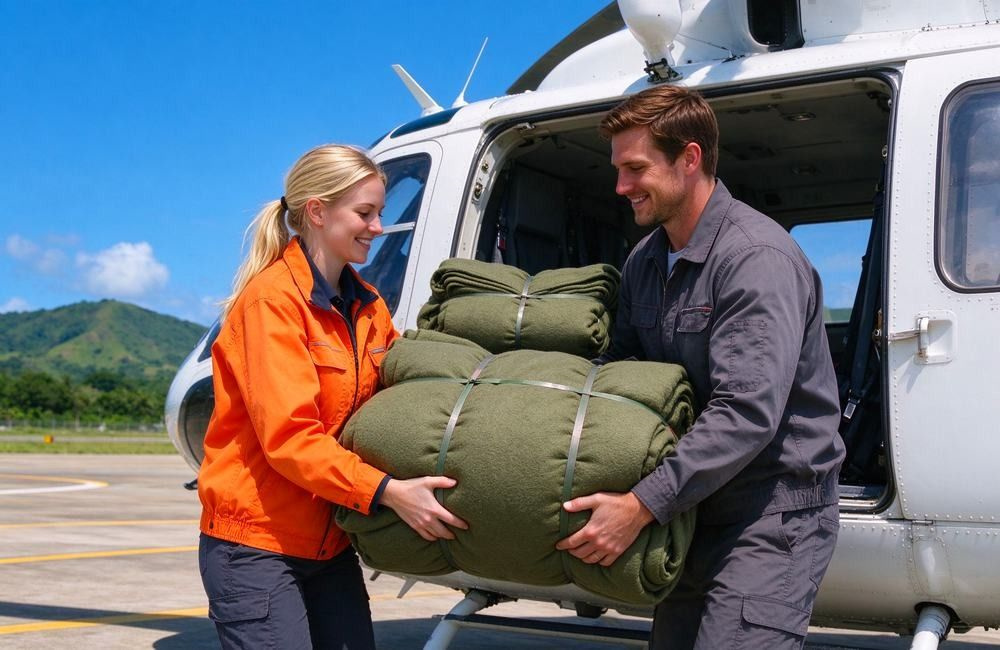
European aid buyer loading wool blend emergency blankets onto rescue helicopter.
The questions field teams ask most when ordering bulk blankets for cold weather, answered in mission, spec, logistics order.
600 to 1000 GSM wool-blend: 600 for transport-heavy missions, 800 for most winter programs, 1000 for extreme cold. Match GSM to the mission.
Count simultaneous users. Define the peak night, add a 10 to 15 percent reserve. A 400-bed shelter orders 440 to 460 blankets.
GSM is grams per square meter; finished weight is the packed weight with seams. A 150×200 cm blanket at 600 GSM is about 1.8 kg, 800 about 2.4 kg.
150×200 cm suits cots and vehicle caches; 180×220 cm suits family bedding and cold camps. State the size split in the RFQ.
Yes. Custom sizing changes the cutting plan and price; custom colours add dyeing and minimum batch. Approve the sample under daylight.
Field programs order hundreds to thousands. Trial orders of 100 to 500 confirm fabric; program orders of 1,000 to 5,000 lock the spec.

A sample confirms GSM, weight, colour and feel before production. Check under daylight and keep the approval record as the baseline.
A pilot lot of 100 to 500 pieces confirms sewing, carton packing and transport survival.
One shipment suits short windows and large storage; scheduled lots suit ongoing programs. Choose by storage, budget and season — and write the logic into the order record for the next reviewer.
Request a pre-shipment check of carton count, labels and one opened carton. Confirm results in writing before freight is released.
Store dry, ventilated and off the floor, issuing oldest batches first. Confirm the space before ordering.
Record count, size, GSM, colour, carton weight, date and batch on the label and in the stock system.
Keep the approved sample record on file; any change needs written approval. Reference it on every repeat order.
Order early enough for production and freight to finish before the first freeze. Confirm lot dates in writing.
Check GSM, weight, nap, stitching, shade, size and label against the approved sample under daylight.
A 30% wool, 70% polyester blend combines warmth and moisture handling with durability and quick drying. The brushed surface traps warm air.

 |

|
Pautan Mesra :
hak cipta © Custom Disaster - Relief Bedding: Tents, Sleeping Bags, Blankets Hak cipta terpelihara
pasukan profesional untuk perkhidmatan !